Other grades of this product :
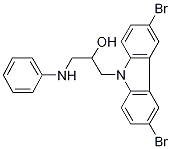
| Product Name: | P7C3 | | Synonyms: | P7C3;1-(3,6-DIBROMO-9H-CARBAZOL-9-YL)-3-(PHENYLAMINO)PROPAN-2-OL;3,6-Dibromo-a-[(phenylamino)methyl]-9H-carbazole-9-ethanol;P7C3, >=98%;6-Dibromo-α-[(phenylamino)methyl]-9H-carbazole-9-ethanol;P7C3; 301353-96-8;CS-1463;P7C3, >97% | | CAS: | 301353-96-8 | | MF: | C21H18Br2N2O | | MW: | 474.19 | | EINECS: | | Product Categories: | Inhibitors;API | | Mol File: | 301353-96-8.mol |
| Boiling point | 656.4±55.0 °C(Predicted) | | density | 1.61±0.1 g/cm3(Predicted) | | storage temp. | 2-8°C | | solubility | DMSO: soluble34mg/mL | | form | powder | | pka | 13.91±0.20(Predicted) | | color | white to off-white | | Stability: | Stable for 2 years from date of purchase as supplied. Solutions in DMSO may be stored at -20°C for up to 2 months |
| Hazard Codes | T | | Risk Statements | 25-41 | | Safety Statements | 26-39-45 | | RIDADR | UN 2811 6.1 / PGIII | | WGK Germany | 3 |
| Description | P7C3 is an orally bioavailable and brain penetrant aminopropyl carbazole that exhibits proneurogenic and neuroprotective activity by preventing apoptosis of newly postmitotic neurons in the subgranular zone of the hippocampal dentate gyrus. At doses of 5 mg/kg and above, it has been shown to promote the survival of neurons in various rodent models of neurodegeneration or nerve injury. While the precise mechanism of action through which these effects are exerted remains uncertain, P7C3 recently has been shown to bind nicotinamide phosphoribosyltransferase, the rate-limiting enzyme involved in the conversion of nicotinamide into NAD. | | Uses | P7C3 is an aminopropyl carbazole agent with proneurogenic and neuroprotective properties in newborn neural precursor cells of the dentate gyrus. Its analogs may be used in neurodegenerative disease research to study the process of neurogenesis in brain regions such as the subgranular zone of the hippocampal dentate gyrus. P7C3 and its analogs may be used to study its pharmacokinetics, metabolism, safety, efficacy and methods of delivery as potential drug for the treatment of condition such as Alzheimer′s disease, Parkinson′s disease, amyotrophic lateral sclerosis and traumatic brain injury. | | Biochem/physiol Actions | P7C3 is neurogenic and protects new neurons against apoptosis. These activities may be related to its capacity to protect mitochondrial integrity.Degeneration of the hippocampus is an early manifestation of Alzheimer′s disease. P7C3 promotes neurogenesis in the subgranular zone of the hippocampal dentate gyrus, the site of normal neurogenesis in adult mammals, making it an important lead compound in development of new Alzheimer′s treatments. | | References | 1) Pieper et al. (2010), Discovery of a proneurogenic, neuroprotective chemical; Cell, 142 39
2) Tesla et al. (2012), Neuroprotective efficacy of aminopropyl carbazoles in a mouse model of amyotrophic lateral sclerosis; Proc. Natl. Acad. Sci. USA, 109 17016
3) De Jesus-Cortes et al. (2012), Neuroprotective efficacy of aminopropyl carbazoles in a mouse model of Parkinson disease; Proc. Natl. Acad. Sci. USA, 109 17010
4) Latchney et al. (2015), Chronic P7C3 treatment restores hippocampal neurogenesis in the Ts65Dn mouse model of Down Syndrome; Neurosci. Lett. 591 86
5) Wang et al. (2014), P7C3 Neuroprotective Chemicals Function by Activating the Rate-Limiting Enzyme in NAD Salvage; Cell, 158 1324 |
| P7C3 Preparation Products And Raw materials |
|


 日本语
日本语 한국어
한국어 Français
 Deutsch
 España
 Türkiye