Other grades of this product :
| KL001 Chemical Properties |
| storage temp. | 2-8°C | | solubility | DMSO: soluble20mg/mL, clear | | form | powder | | color | white to beige | | Stability: | Stable for 2 years from date of purchase as supplied. Solutions in DMSO or ethanol may be stored at -20° for up to 3 months. |
| Hazard Codes | Xn | | Risk Statements | 22 | | WGK Germany | 3 |
| KL001 Usage And Synthesis |
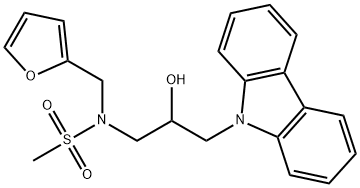
| Description | KL-001 (309928-48-1) is a novel tool that specifically interacts with cryptochrome (CRY) preventing its ubiquitin-dependent degradation resulting in lengthening of the circadian period. KL-001-mediated CRY stabilization inhibits glucagon-induced gluconeogenesis in primary hepatocytes.1?Binds to the FAD-binding pocket of CRY2 as determined by co-crystal structure.2?KL-001 induces an increase in period along with simultaneous reduction in amplitude of circadian reporter expression3 in mammalian cells. | | Uses | KL001 is a small molecule that specifically interacts with cryptochrome (CRY). KL001 prevented ubiquitin-dependent degrdation of CRY, resulting in lengthening of the circadian period. KL001-mediated CRY stabilization inhibited glucagon-induced gluconeogenesis in primary hepatocytes making it a tool to study the regulation of CRY-dependent physiology and aid development of clock-based therapeutics of diabetes. | | Biochem/physiol Actions | KL001 stabilizes cryptochrome (CRY), preventing ubiquitin-dependent degradation. CRY proteins are part of a feedback loop, acting as transcription repressors to inhibit CLOCK-BMAL1 components of the circadian clock. KL001 stabilization of CRY proteins results in lengthening of the circadian period, and also inhibited glucagon-induced gluconeogenesis in primary hepatocytes. Other compounds affecting circadian rhythms include Casein kinase I (CKI) inhibitors such as longdaysin (Sigma Prod. No. SML0127) and synthetic ligands for the nuclear receptors REV-ERB such as SR8278 (Sigma Prod. No. S9576), but KL001 appears to be the first small molecule that specifically acts on CRY proteins. | | References | 1) Hirota et al. (2012), Identification of small molecule activators of cryptochrome; Science, 337 1094
2) Nangle et al. (2013), Crystal structure of mammalian cryptochrome in complex with a small molecule competitor of its ubiquitin ligase; Cell Res., 23 1417
3) St. John et al. (2014), Spatiotemporal separation of PER and CRY posttranslational regulation in the mammalian circadian clock; Proc. Natl. Acad. Sci. USA, 11 2040 |
| KL001 Preparation Products And Raw materials |
|


 日本语
日本语 한국어
한국어 Français
 Deutsch
 España
 Türkiye