Other grades of this product :
| PTC-209 (PTC209 Basic information |
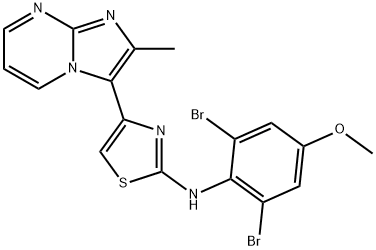
| Product Name: | PTC-209 (PTC209 | | Synonyms: | PTC-209 (PTC209;PTC-209;N-(2,6-dibroMo-4-Methoxyphenyl)-4-(2-MethyliMidazo[1,2-a]pyriMidin-3-yl)thiazol-2-aMine;N-(2,6-Dibromo-4-methoxyphenyl)-4-(2-methylimidazo[1,2-a]pyrimidin-3-yl)-2-thiazolamine;N-(2,6-Dibromo-4-methoxyphenyl)-4-(2-methylimidazo[1,2-a]pyrimidin-3-yl)-2-thiazolamine PTC-209;PTC-209, >=98%;2-THIAZOLAMINE, N-(2,6-DIBROMO-4-METHOXYPHENYL)-4-(2-METHYLIMIDAZO[1,2-A]PYRIMIDIN-3-YL)-;PTC-209 free base | | CAS: | 315704-66-6 | | MF: | C17H13Br2N5OS | | MW: | 495.19 | | EINECS: | 808-910-7 | | Product Categories: | Inhibitors | | Mol File: | 315704-66-6.mol |
| PTC-209 (PTC209 Chemical Properties |
| density | 1.86±0.1 g/cm3(Predicted) | | storage temp. | 2-8°C | | solubility | DMSO: soluble20mg/mL, clear | | pka | 3.77±0.30(Predicted) | | form | powder | | color | white to brown | | Stability: | Stable for 1 year as supplied. Solutions in DMSO may be stored at -20°C for up to 3 months. | | CAS DataBase Reference | 315704-66-6 |
| Hazard Codes | T | | Risk Statements | 25 | | Safety Statements | 45 | | RIDADR | UN 2811 6.1 / PGIII |
| PTC-209 (PTC209 Usage And Synthesis |
| Description | PTC-209 (315704-66-6) is an inhibitor of BMI-1 (IC50 = 500 nM), part of the polycomb repressive complex 1 (PCR1).1? It inhibited endogenous BMI-1 expression in human colorectal HCT116 and human fibrosarcoma HT1080 tumor cells resulting in reduced tumor volume as well as reduced cancer initiating cell (CIC) number.?? PTC-209 displayed potent in vivo antitumor effects in several cancer models including breast2, head and neck3, glioblastoma4, prostate5, colon5, and rhabdomyosarcoma6. It also promoted chemically-induced direct cardiac reprogramming of cardiac fibroblasts into cardiac myocytes.7,8 | | Uses | Polycomb complex protein BMI-1 is a polycomb ring finger oncogene that regulates the p16 and p19 cell cycle inhibitor genes. It is necessary for efficient self-renewing cell divisions of stem cells in several tissues and can be over-expressed in tumors. PTC-209 is a BMI-1 inhibitor (IC50 = ~ 0.5 μM) that irreversibly impairs colorectal cancer-initiating cell (CIC) growth. It reduces tumor growth in CIC xenograft assays and abrogates colorectal cancer cell self-renewal in vivo, reducing their tumorigenic potential.[Cayman Chemical] | | Uses | PTC 209 is a compound involved in thedown-reglation of NOTCH signaling and aids in suppressing acute leukemia cells. | | Uses | PTC-209 has been used as a B lymphoma Mo-MLV insertion region 1 homolog (BMI1) inhibitor to study its effects on: - the cell viability of canine osteosarcoma (OSA) cell lines
- lipidated microtubule-associated protein 1 light chain 3 (LC3B-II) and Sequestosome 1 (SQSTM1) protein levels in ovarian cancer (OvCa) cells
- cardiac reprogramming efficiency in mouse embryonic fibroblasts (MEF)
| | Biochem/physiol Actions | PTC-209 inhibits the expression of the oncogene BMI-1 (B lymphoma Mo-MLV insertion region 1 homolog), which encodes a polycomb group RING finger protein involved in cell cycle. PTC-209 lowers the self-renewal properties of colorectal cancer-initiating cells (CICs) The compound inhibits tumor growth, and reduces the levels of CICs present in colon cancer tumor xenografts in mice. | | References | Kreso et al. (2013), Self-renewal as a therapeutic target in human colorectal cancer; Nat. Med. 20 29
Srinivasan et al. (2017), Downregulation of Bmi1 in breast cancer stem cells suppresses tumor growth and proliferation; Oncotarget. 8 38731
Wang et al. (2017), Pharmacological inhibition of Bmi1 by PTC-209 impaired tumor growth in head neck squamous cell carcinoma; Cancer Cell Int. 17 107
Kong et al. (2018), Targeting of BMI-1 with PTC-209 inhibits glioblastoma development; Cell Cycle 17 1199
Elango et al. (2019), Concurrent targeting of BMI1 and CDK4/6 abrogates tumor growth in vitro and in vivo; Sci. Rep. 9 13696
Shields et al. (2021), Epigenetic regulator BMI1 promotes alveolar rhabdomyosarcoma proliferation and constitutes a novel therapeutic target; Mol. Oncol. 1002/1878-0261.12914
Guo et al. (2019), Chemical suppression of specific C-C chemokine signaling pathways enhances cardiac reprogramming; J. Biol. Chem. 294 9134
Testa et al.. (2020),Bmi1 inhibitor PTC-209 promotes Chemically-induced Direct Cardiac Reprogramming of cardiac fibroblasts into cardiomyocytes; Sci. Rep. 10 7129 |
| PTC-209 (PTC209 Preparation Products And Raw materials |
|


 日本语
日本语 한국어
한국어 Français
 Deutsch
 España
 Türkiye