Other grades of this product :
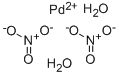
| Palladium(II) nitrate dihydrate Basic information |
| Palladium(II) nitrate dihydrate Chemical Properties |
| density | 1.118 g/mL at 25 °C | | storage temp. | Store below +30°C. | | form | Liquid | | Sensitive | Hygroscopic | | Merck | 14,6992 | | Exposure limits | ACGIH: TWA 2 ppm; STEL 4 ppmOSHA: TWA 2 ppm(5 mg/m3)NIOSH: IDLH 25 ppm; TWA 2 ppm(5 mg/m3); STEL 4 ppm(10 mg/m3) |
| Hazard Codes | C | | Risk Statements | 34 | | Safety Statements | 26-36/37/39-45 | | RIDADR | UN 3264 8/PG 2 | | WGK Germany | 3 | | HazardClass | 8 | | PackingGroup | II | | HS Code | 2834298000 |
| Palladium(II) nitrate dihydrate Usage And Synthesis |
| Uses | Palladium(II) nitrate dehydrate is used as a reactant for:- Doping activated carbon for catalysis
- Catalytic use of hydroxyapatite (HAP) supported Pd nanoclusters in the hydrolysis of ammonia-borane.
It′s used as catalyst for:- Selective hydrogenation of 1-heptyne and napthalene
- In highly porous coordination polymer MIL-101 support.
It may also be used as a reactant for:- Preparation of platinum-palladium/carbon alloy nanocatalysts for methanol-tolerant oxygen reduction reaction in fuel cells
- Synthesis of Cu-Pd alloy thin films on Ti substrates by co-electrodeposition of Pd and Cu from nitrate-base electrolytic baths
- Preparation of palladium catalyst supported on vertically aligned multi-walled carbon nanotubes for microwave-assisted Heck reactions of p-iodonitrobenzene with styrene and Et acrylate
- Preparation of di-phenyl sulfide-modified Pd/TiO2 catalysts for acetylene hydrogenation
|
| Palladium(II) nitrate dihydrate Preparation Products And Raw materials |
|


 日本语
日本语 한국어
한국어 Français
 Deutsch
 España
 Türkiye