Other grades of this product :
| ANTIPAIN, DIHYDROCHLORIDE Basic information |
| ANTIPAIN, DIHYDROCHLORIDE Chemical Properties |
| Melting point | 209-217 °C | | Boiling point | 652.92°C (rough estimate) | | density | 1.2423 (rough estimate) | | refractive index | 1.6500 (estimate) | | storage temp. | -20°C | | solubility | H2O: 50 mg/mL | | form | White powder | | color | White | | Water Solubility | 0.01M in water | | Stability: | Stable for 1 year from date of purchase as supplied. Solutions in distilled water may be stored at -20°C for up to 1 month. |
| Safety Statements | 22-24/25 | | WGK Germany | 3 | | RTECS | YV9350800 | | F | 1-10 | | HS Code | 2934999090 |
| ANTIPAIN, DIHYDROCHLORIDE Usage And Synthesis |
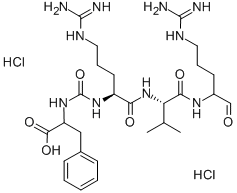
| Description | Antipain is a protease inhibitor originally isolated from actinomycetes. It inhibits thrombokinase, plasmin, trypsin, and papain in vitro (IC50s = 20, 93, 0.26, and 0.16 μg/ml, respectively). Antipain (6-600 μg/ml) inhibits the morphological transformation of and increases frequency of chromosomal aberrations in Syrian hamster embryo cells induced by N-methyl-N''-nitro-N-nitroso-guanidine (MNNG). In vivo, antipain (25-100 mg/kg) suppresses urethan-induced formation of cleft palates and cleft lips in mice. | | Uses | Concentrations for 50% inhibition (μg/ml): papain, 0.16trypsin, 0.26cathepsin A, 1.19cathepsin B, 0.59cathepsin D, 125plasmin, >93chymotrypsin and pepsin, >250It also has been reported to inhibit calpain I, (porcine) with Ki = 1.4 μM | | Uses | Antipain inhibits trypsin, papain, and catherpsins A and B (a reversible inhibitor of cysteine and serine proteases). It is used to evaluate the role of proteases in cell transformations. It is used to help identify new proteases. | | General Description | Antipain is a protease inhibitor isolated from actinomycetes. It inhibits thrombokinase and blood coagulation. | | Biochem/physiol Actions | Reversible inhibitor of serine/cysteine proteases and some trypsin-like serine proteases. Its action resembles leupeptin; however, its plasmin inhibition is less and its cathepsin A inhibition is more than that observed with leupeptin. Chronic administration of antipain can reduce the frequency of chemically induced transformation in BALB/c-/3T3 cells. | | References | 1) Umezawa?et al.?(1976),?Structures and activities of protease inhibitors of microbial origin; Method Enzymol.,?45?678
2) Gotoh?et al.?(2001),?Proteolytic activity and recombinant protein production in virus-infected Sf-9 insect cell cultures supplemented with carboxyl and cysteine protease inhibitors; J. Biosci. Bioeng.,?92?248
3) Hockensmith?et al. (2016), Identification and characterization of a chymotrypsin-like serine protease from periodontal pathogen, Tannerella forsythia; Microb. Pathog.,?100?37
4) Mat Amin?et al. (2004),?Proteinases in Naegleria Fowleri (strain NF3), a pathogenic amoeba: a preliminary study.; Trop. Biomed.,?21?57
5) Moriyyasu & Inoue (2008),?Use of protease inhibitor for detecting autophagy in plants; Methods Enzymol.,?451?557 |
| ANTIPAIN, DIHYDROCHLORIDE Preparation Products And Raw materials |
|


 日本语
日本语 한국어
한국어 Français
 Deutsch
 España
 Türkiye