Other grades of this product :
| CORTICOSTERONE Basic information |
| CORTICOSTERONE Chemical Properties |
| Melting point | 179-183 °C(lit.) | | alpha | D15 +223° (c = 1.1 in alc) | | Boiling point | 401.19°C (rough estimate) | | density | 1.0413 (rough estimate) | | refractive index | 1.4430 (estimate) | | Fp | 9℃ | | storage temp. | -20°C | | solubility | Chloroform (Sparingly, Sonicated), Ethanol (Slightly, Sonicated), Methanol (Slig | | form | White to tan crystalline powder | | color | White to Pale Yellow | | optical activity | [α]20/D +223±3°, c = 1% in ethanol | | Water Solubility | 240.5mg/L(37 ºC) | | Merck | 2538 | | BRN | 2339601 | | Stability: | Stable, but light sensitive. Incompatible with strong oxidizing agents. | | CAS DataBase Reference | 50-22-6(CAS DataBase Reference) | | EPA Substance Registry System | Corticosterone (50-22-6) |
| Hazard Codes | Xi,N,Xn,T,F | | Risk Statements | 43-40-39/23/24/25-23/24/25-11 | | Safety Statements | 36-22-45-36/37-16 | | RIDADR | UN1230 - class 3 - PG 2 - Methanol, solution | | WGK Germany | 3 | | RTECS | GM7650000 | | HS Code | 29372900 | | Toxicity | An adrenocortical steroid with modest glucocorticoid
and mineralocorticoid activity. It is the primary glucocorticoid
in the rat. |
| CORTICOSTERONE Usage And Synthesis |
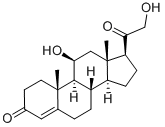
| Description | Corticosterone is a steroid hormone produced in the cortex of the adrenal glands that binds to both glucocorticoid and mineralocorticoid receptors. It is produced in response to ACTH (corticotropic hormone) and is the precursor to aldosterone synthesis. Since the production of glucocorticoids is increased by stress, it is often used as a biomarker of stress. Plasma corticosterone levels have a circadian variation and corticosterone may be important in the regulation of the sleep-wake cycle. | | Chemical Properties | white to light yellow powder | | Uses | Glucocorticoid; an intermediate in the biosynthesis of aldosterone, isolated from the adrenal cortex. | | Uses | Corticosterone: HBC complex has been used: - in the intravenous and intraperitoneal administration of corticosterone to rats to test its effect on glucocorticoid and mineralocorticoid activity
- to induce acute stress in mice
- in Pulsatile treatment in mice to test its effect on clock gene period 1 transcription
| | Uses | Corticosteroid is an activator of MCR. | | Definition | ChEBI: A 21-hydroxy steroid that consists of pregn-4-ene substituted by hydroxy groups at positions 11 and 21 and oxo groups at positions 3 and 20. Corticosterone is a 21-carbon steroid hormone of the corticosteroid type produced in the cortex of the adrenal glan
s. | | General Description | Corticosterone is a corticosteroid and aldosterone precursor produced in the adrenal glands. Serum corticosterone levels are measured by LC-MS/MS for newborn screening and diagnosis of 11-hydroxylase deficiency. | | Biological Activity | Endogenous glucocorticoid that acts as an agonist at glucocorticoid and mineralocorticoid receptors. | | Biochem/physiol Actions | The complex of corticosterone with 2-hydroxypropyl-β-cyclodextrin (HBC) improves water solubility. HBC is a carrier molecule. Corticosterone is a rodent-specific primary adrenal corticosteroid. It displays affinity towards the glucocorticoid and mineralocorticoid receptors. | | Purification Methods | Purify corticosterone by recrystallisation from Me2CO (trigonal plates), EtOH or isoPrOH. It has UV max at 240nm, and gives an orange-yellow solution with strong fluorescence on treatment with concentrated H2SO4. It is insoluble in H2O but soluble in organic solvents. [Reichstein & Euw Helv Chim Acta 2 1 1197 1938, 2 7 1287 1944; Mason et al. J Biol Chem 114 613 1936; ORD: Foltz et al. J Am Chem Soc 7 7 4359 1955; NMR: Shoolery & Rogers J Am Chem Soc 8 0 5121 1958.] The 21-O-acetyl derivative [1173-26-8] crystallises from Me2CO/Et2O with m 152.5-153o, [] D 20 +195o (c 0.6, Me2CO), and the 21-O-benzoyl derivative crystallises from AcOH/Et2O with m 201-202o [Reichstein Helv Chim Acta 2 0 953 1937]. [Beilstein 8 IV 2907.] |
| CORTICOSTERONE Preparation Products And Raw materials |
|


 日本语
日本语 한국어
한국어 Français
 Deutsch
 España
 Türkiye