Other grades of this product :
| ASP-ARG-VAL-TYR-ILE-HIS-PRO Basic information |
| ASP-ARG-VAL-TYR-ILE-HIS-PRO Chemical Properties |
| Melting point | >202°C (dec.) | | density | 1.47±0.1 g/cm3(Predicted) | | storage temp. | −20°C | | solubility | DMSO (Slightly), Methanol (Slightly), Water (Slightly, Sonicated) | | form | powder | | pka | 3.29±0.20(Predicted) | | color | White to Off-White |
| ASP-ARG-VAL-TYR-ILE-HIS-PRO Usage And Synthesis |
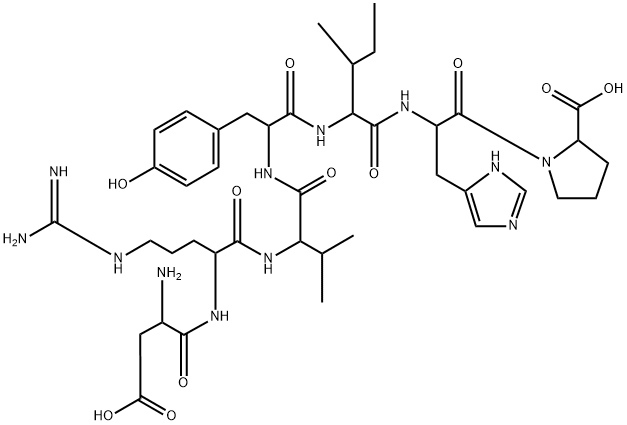
| Uses | Angiotensin (1-7) can be used in biological study and engineering or chemical process of mechanisms of peptide oxidation by hydroxyl radicals. | | Biological Activity | ang-(1-7) (h - asp - arg - val - tyr - ile - his - pro - oh) is an endogenous peptide fragment that can be produced from ang i or ang ii via endo- or carboxy-peptidases respectively[1].as described for ang ii, ang-(1-7) also has a broad range of effects in different organs and tissues and goes beyond its initially described cardiovascular and renal actions. those effects are mediated by mas and can counter-regulate most of the deleterious effects of ang ii. the interaction ang-(1-7)/mas regulates different signaling pathways, such as pi3k (phosphoinositide 3-kinase)/akt and erk (extracellular signal-regulated kinase) pathways and involves downstream effectors such as no, foxo1 (forkhead box o1) and cox-2 (cyclo-oxygenase-2). through these mechanisms, ang-(1-7) is able to improve pathological conditions including fibrosis and inflammation in organs such as lungs, liver and kidney. [2]in addition, this heptapeptide has positive effects on metabolism, increasing the glucose uptake and lipolysis while decreasing insulin resistance and dyslipidemia. ang-(1-7) is also able to improve cerebroprotection against ischemic stroke, besides its effects on learning and memory. the reproductive system can also be affected by ang-(1-7) treatment, with enhanced ovulation, spermatogenesis and sexual steroids synthesis. finally, ang-(1-7) is considered a potential anti-cancer treatment since it is able to inhibit cell proliferation and angiogenesis.[2]fig. 1: formula of angiotensin (1-7)fig. 2: cascade of the processing of angiotensin peptides and their interaction with at1 and at1-7 receptor systems. | | Biochem/physiol Actions | Angiotensin I metabolite that is an AT2 receptor agonist. | | references | 1. Santos et al (2000) Angiotensin-(1-7): an update. Regul.Pept. 91 45.2. Danielle G. P., Thiago V., Robson A. S. Angiotensin-(1-7): beyond the cardio-renal actions. Clinical Science (2013) 124, (443–456) |
| ASP-ARG-VAL-TYR-ILE-HIS-PRO Preparation Products And Raw materials |
|


 日本语
日本语 한국어
한국어 Français
 Deutsch
 España
 Türkiye