Other grades of this product :
| Salinomycin Basic information |
| Salinomycin Chemical Properties |
| Melting point | 112.5-113.5 °C(lit.) | | alpha | D25 -63° (c = 1 in ethanol) | | Boiling point | 839.2±65.0 °C(Predicted) | | density | 1.18±0.1 g/cm3(Predicted) | | Fp | >110°(230°F) | | storage temp. | Sealed in dry,2-8°C | | solubility | insoluble in H2O; ≥142.2 mg/mL in EtOH; ≥91.8 mg/mL in DMSO | | form | White solid | | pka | 6.4 (DMF) | | Water Solubility | Soluble in methanol. Insoluble in water | | Merck | 13,8415 | | Stability: | Stable, but may be heat sensitive - keep cool. Incompatible with strong oxidizing agents. | | CAS DataBase Reference | 53003-10-4(CAS DataBase Reference) |
| Provider | Language |
|
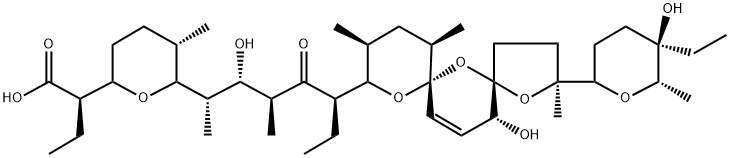
(2R)-2-((5S)-6-{5-[(10S,12R)-2-((6S,5R)-5-Ethyl-5-hydroxy-6-methylperhydro-2H-pyran-2-yl)-15-hydroxy-2,10,12-trimethyl-1,6,8-trioxadispiro[4.1.5.3]pentadec-13-en-9-yl](1S,2S,3S,5R)-2-hydroxy-1,3-dimethyl-4-oxoheptyl}-5-methylperhydro-2H-pyran-2-yl)butanoic acid
| English |
|
SigmaAldrich
| English |
| Salinomycin Usage And Synthesis |
| Chemical Properties | solid | | Uses | antibacterial | | Uses | Salinomycin is a polyether ionophore with broad spectrum Gram positive and anti-coccidial activity. Salinomycin has a high affinity for monovalent cations, particularly potassium. Salinomycin is used to control coccidia in animals and for growth promotion in ruminants. Recently, salinomycin has been shown to inhibit cancer stem cells and is >100 times more potent than taxol. While the mechanism of action is unknown, it was noted that among the 60,000 compounds screened, another monovalent ionophore, nigericin, and a chloride channel inhibitor, avermectin, were also active. | | Uses | Salinomycin was used as a standard in the development of LC-MS/MS method for detection of residual coccidiostats in egg and muscle samples. It was used to screen out CD44+CD24- mesenchymal-like subpopulation within breast carcinomas. | | General Description | Chemical structure: polyether | | Biological Activity | salinomycin (sal), which is a polyether ionophore antibiotic from streptomyces albus, has been proven to be able to kill different types of human cancer cells, most likely via interfering with abc drug transporters, the wnt/β-catenin signaling pathway, or other pathways. | | Biochem/physiol Actions | Salinomycin produced by Streptomyces albus is a carboxylic polyether ionophore with antibiotic and anti-cancer properties. It induces cell death in some types of cancer cells such as breast, lung, gastric cancer, leukemia and osteosarcoma. Salinomycin inhibits multidrug resistance protein 1 and induces apoptosis by the generation of reactive oxygen species that cause DNA damage and inactivation of Stat3. Use of salinomycin as antibiotic results in lowered spermatozoa count and motility and decreased steroidogenesis in mice. | | in vitro | several hepatocellular carcinoma (hcc) cell lines were treated with sal. results showed that sal inhibited proliferation and decreased pcna levels. cell cycle analysis showed that sal caused cell cycle arrest in different phases. sal induced apoptosis as characterized by an increase in the bax/bcl-2 ratio. compared to control, β-catenin expression was down-regulated by sal treatment significantly. the ca2+ concentration in hcc cells was examined by flow cytometry and it was found that higher ca2+ concentrations were observed in sal treatment groups [1]. | | in vivo | the in vivo anti-tumor effect of sal was verified using the hepatoma orthotopic tumor model and results showed that the liver tumor size in sal-treated groups decreased. immunohistochemistry and tunel staining also demonstrated that sal could in vivo inhibit proliferation and induced apoptosis [1]. | | IC 50 | 7.7, 13.7 and 10.4 μm for hepg2, smmc-7721 and bel-7402 cell line, respectively (after 24h treatment) | | references | [1] wang f,he l,dai wq,xu yp,wu d,lin cl,wu sm,cheng p,zhang y,shen m,wang cf,lu j,zhou yq,xu xf,xu l,guo cy. salinomycin inhibits proliferation and induces apoptosis of human hepatocellular carcinoma cells in vitro and in vivo. plos one.2012;7(12):e50638. |
| Salinomycin Preparation Products And Raw materials |
|

 日本语
日本语 한국어
한국어 Français
 Deutsch
 España
 Türkiye