Other grades of this product :
| FUSARIC ACID Basic information |
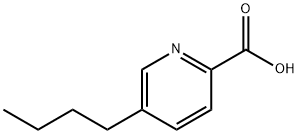
| Product Name: | FUSARIC ACID | | Synonyms: | FUSARIC ACID;FURASIC ACID;5-N-BUTYL-2-PICOLINIC ACID;5-N-BUTYLPICOLINIC ACID;5-BUTYL-2-PYRIDINECARBOXYLIC ACID;5-BUTYLPICOLINIC ACID;5-BUTYLPYRIDINE-2-CARBOXYLIC ACID;5-butyl-2-pyridinecarboxylicaci | | CAS: | 536-69-6 | | MF: | C10H13NO2 | | MW: | 179.22 | | EINECS: | 208-643-0 | | Product Categories: | | Mol File: | 536-69-6.mol |
| FUSARIC ACID Chemical Properties |
| Melting point | 96-100 °C | | Boiling point | 311.75°C (rough estimate) | | density | 1.1248 (rough estimate) | | refractive index | 1.5710 (estimate) | | storage temp. | Inert atmosphere,Store in freezer, under -20°C | | solubility | ethanol: 50 mg/mL, clear, faintly yellow | | form | Crystalline Powder | | pka | 1.11±0.50(Predicted) | | color | Off-white to faint yellow | | Merck | 14,4314 | | BRN | 125804 | | CAS DataBase Reference | 536-69-6(CAS DataBase Reference) | | EPA Substance Registry System | 2-Pyridinecarboxylic acid, 5-butyl- (536-69-6) |
| Hazard Codes | Xn | | Risk Statements | 22 | | Safety Statements | 24/25 | | RIDADR | 2811 | | WGK Germany | 3 | | RTECS | US5625000 | | F | 10 | | HazardClass | 6.1(b) | | PackingGroup | III | | HS Code | 29333999 | | Hazardous Substances Data | 536-69-6(Hazardous Substances Data) | | Toxicity | LD50 orally in mice: 230 mg/kg (Ishii) |
| FUSARIC ACID Usage And Synthesis |
| Chemical Properties | off-white to faint yellowish crystalline powder | | Uses | A medical research tool. | | Uses | Fusaric acid may be used as a derivatizing reagent for the quantification of hydroxysteroids and dehydroepiandrosterone (DHEA)?and sulfated DHEA in biological samples using liquid chromatography electrospray-ionization-tandem mass spectrometry (LC/ESI-MS/MS) technique. | | Definition | A mycotoxin and picolinic acid, that is an antibiotic and wilting agent that causes yellowing of infected plants. | | Synthesis Reference(s) | The Journal of Organic Chemistry, 66, p. 605, 2001 DOI: 10.1021/jo0013554 | | General Description | Fusaric acid is a novel proton-affinitive derivatizing agent, having an ionization moiety and a hydrophobic moiety. It is commonly used for the derivatization of alcohols and phenols, by liquid chromatography coupled with electrospray ionization tandem mass spectrometry (LC/ESI-MS/MS). | | Hazard | Very toxic. | | Biological Activity | fusaric acid is a mycotoxin produced by several species of fusarium [1]. mycotoxins are biologically active secondary fungal metabolites found as contaminants of food- and feedstuff. mycotoxin is capable of causing disease and death in both humans and animals.fusaric acid is a potent inhibitor of dopamine β-hydroxylase. fusaric acid uncompetitively inhibited the activity of dopamine β-hydroxylase with an ic50 of 30 μm in an. fusaric acid lowered endogenous levels of norepinephrine and epinephrine in brain, spleen, heart, and adrenal glands. fusaric acid inhibited dopamine β-hydroxylase activity in adrenal medulla in vivo [2]. fusaric acid altered brain and pineal neurotransmitters. in the brain and pineal gland of rats, intraperitoneally (100 mg/kg) administration of fusaric acid increased the level of 5ht, 5-hydroxyindoleacetic acid (5hiaa), tyrosine, and dopamine [3].exposure to acute doses of fusaric acid caused vomiting and neurochemical changes in swine. fusaric acid might act synergistically with trichothecene mycotoxins to cause vomiting and feed refusal in pigs consuming trichothecene-contaminated feedstuffs [4]. | | Safety Profile | A poison by ingestion,
intraperitoneal, subcutaneous, and
intravenous routes. When heated to
decomposition it emits toxic fumes of NOx. | | Purification Methods | Dissolve it in CHCl3, dry (Na2SO4), filter, evaporate and recrystallise the residue from 50 parts of pet ether (b 40-60o), CHCl3/pet ether or EtOAc, then sublime it in vacuo. The amide crystallises from MeOH with m 128.2-129.0o. The copper salt forms bluish violet crystals from H2O and has m 258-259o. [Hardegger & Nikles Helv Chim Acta 39 505 1956, Schreiber & Adam Chem Ber 93 1848 1960, NMR and MS: Tschesche & Führer Chem Ber 111 3500 1978, Beilstein 22 III/IV 764, 22/2 V 384.] | | references | [1] hidaka h, nagatsu t, takeya k, et al. fusaric acid, a hypotensive agent produced by fungi[j]. the journal of antibiotics, 1969, 22(5): 228-230.[2] toshiharu n, hiroyoshi h, hiroshi k, et al. inhibition of dopamine β-hydroxylase by fusaric acid (5-butylpicolinic acid) in vitro and in vivo[j]. biochemical pharmacology, 1970, 19(1): 35-44.[3] porter j k, bacon c w, wray e m, et al. fusaric acid in fusarium moniliforme cultures, corn, and feeds toxic to livestock and the neurochemical effects in the brain and pineal gland of rats[j]. natural toxins, 1995, 3(2): 91-100.[4] smith t k, macdonald e j. effect of fusaric acid on brain regional neurochemistry and vomiting behavior in swine[j]. journal of animal science, 1991, 69(5): 2044-2049. |
| FUSARIC ACID Preparation Products And Raw materials |
|


 日本语
日本语 한국어
한국어 Français
 Deutsch
 España
 Türkiye