Other grades of this product :
| Sinapyl alcohol Basic information |
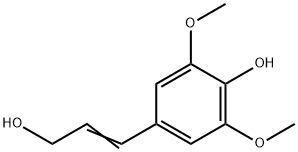
| Product Name: | Sinapyl alcohol | | Synonyms: | SINAPYL ALCOHOL;3,5-DIMETHOXY-4-HYDROXYCINNAMYL ALCOHOL;4-HYDROXY-3,5-DIMETHOXYCINNAMYL ALCOHOL;SINAPYL ALCOHOL, TECH., 80%;3-(3,5-Dimethoxy-4-hydroxyphenyl)-2-propen-1-ol;3-(4-Hydroxy-3,5-dimethoxyphenyl)-2-propene-1-ol;p-Synapyl alcohol;3-(4-Hydroxy-3,5-dimethoxyphenyl)-2-propen-1-ol | | CAS: | 537-33-7 | | MF: | C11H14O4 | | MW: | 210.23 | | EINECS: | | Product Categories: | Benzhydrols, Benzyl & Special Alcohols | | Mol File: | 537-33-7.mol |
| Sinapyl alcohol Chemical Properties |
| Melting point | 61-65 °C (lit.) | | Boiling point | 384.7±37.0 °C(Predicted) | | density | 1.205±0.06 g/cm3(Predicted) | | storage temp. | 2-8°C | | solubility | Acetonitrile (Slightly), Chloroform (Slightly) | | form | Oil | | pka | 10.00±0.40(Predicted) | | color | Pale Yellow to Yellow Thick | | Stability: | Light Sensitive |
| Hazard Codes | Xi | | Risk Statements | 36/37/38 | | Safety Statements | 26 | | WGK Germany | 3 |
| Sinapyl alcohol Usage And Synthesis |
| Description | Sinapyl alcohol is an organic compound structurally related to cinnamic acid. It is biosynthetized via the phenylpropanoid biochemical pathway, its immediate precursor being sinapaldehyde. This phytochemical is one of the monolignols, which are precursor to lignin or lignans. It is also a biosynthetic precursor to various stilbenoids and coumarins. | | Uses | Sinapyl alcohol, a monolignol, is a primary lignin monomer. It has been evaluated for anti-inflammatory and antinociceptive activities. It participates in the initial stages in the biosynthesis of lignin. Coupling reactions of sinapyl alcohol and sinapyl p-hydroxybenzoate has been reported. Preparation of sinapyl alcohol by selective 1,2-reduction of corresponding cinnamate esters using diisobutylaluminium hydride as reducing agent has been studied. | | Uses | Sinapyl Alcohol is useful for producing nail polish made of wood. | | Uses | Sinapyl alcohol may be employed in the preparation of lignin, a highly stable biopolymer. | | Definition | ChEBI: Sinapyl alcohol is a primary alcohol, being cinnamyl alcohol hydroxylated at C-4 and methoxylated at C-3 and -5. It has a role as a plant metabolite. It is a primary alcohol, a member of phenols and a dimethoxybenzene. It derives from a cinnamyl alcohol. | | General Description | Sinapyl alcohol, a monolignol, is a primary lignin monomer. It has been evaluated for anti-inflammatory and antinociceptive activities. It participates in the initial stages in the biosynthesis of lignin. Coupling reactions of sinapyl alcohol and sinapyl p-hydroxybenzoate has been reported. Preparation of sinapyl alcohol by selective 1,2-reduction of corresponding cinnamate esters using diisobutylaluminium hydride as reducing agent has been studied. | | Biological Activity | Sinapyl alcohol is a monolignol and an aglycone form of syringin that has been found in Populus alba and has anti-inflammatory and antinociceptive activities. It is a precursor in the biosynthesis of lignin. Sinapyl alcohol (50, 100, and 200 μM) reduces LPS-induced production of nitrite, prostaglandin E2 (PGE2), and TNF-α in RAW 264.7 cells. Sinapyl alcohol (20 and 30 mg/kg) inhibits acetic acid-induced writhing and increases the latency to paw licking in the hot plate test in mice. | | Preparation and handling | Sinapyl alcohol is supplied as a neat oil. A stock solution may be made by dissolving the sinapyl alcohol in the solvent of choice, which should be purged with an inert gas. Sinapyl alcohol is soluble in organic solvents such as ethanol, DMSO, and dimethyl formamide. The solubility of sinapyl alcohol in these solvents is approximately 30 mg/ml.Further dilutions of the stock solution into aqueous buffers or isotonic saline should be made prior to performing biological experiments. Ensure that the residual amount of organic solvent is insignificant, since organic solvents may have physiological effects at low concentrations. Organic solvent-free aqueous solutions of sinapyl alcohol can be prepared by directly dissolving the neat oil in aqueous buffers. The solubility of sinapyl alcohol in PBS (pH 7.2) is approximately 1 mg/ml. We do not recommend storing the aqueous solution for more than one day. |
| Sinapyl alcohol Preparation Products And Raw materials |
|

 日本语
日本语 한국어
한국어 Français
 Deutsch
 España
 Türkiye