Other grades of this product :
| Nicardipine hydrochloride Basic information |
| Nicardipine hydrochloride Chemical Properties |
| Melting point | 176-1780C | | storage temp. | 2-8°C | | solubility | DMSO: ~1 mg/mL | | form | powder | | color | yellow | | Merck | 14,6495 | | Stability: | Stable for 1 year from date of purchase as supplied. Solutions in distilled water or ethanol may be stored at -20°C for up to 1 month. | | InChIKey | AIKVCUNQWYTVTO-UHFFFAOYSA-N | | CAS DataBase Reference | 54527-84-3(CAS DataBase Reference) |
| Hazard Codes | T | | Risk Statements | 23/24/25 | | Safety Statements | 36/37/39-45 | | RIDADR | UN 2811 6.1/PG 3 | | WGK Germany | 3 | | RTECS | US7972100 | | HazardClass | 6.1(b) | | PackingGroup | III | | HS Code | 2933399090 | | Toxicity | LD50 in male, female rats (mg/kg): 634, 557 orally; 18.1, 25.0 i.v.; in male, female mice: 634, 650 orally; 20.7, 19.9 i.v. (Odani, Sado) |
| Nicardipine hydrochloride Usage And Synthesis |
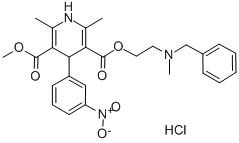
| Description | Nicardipine is a dihydropyridine L-type calcium channel antagonist that displays antihypertensive and antianginal activity. It is reported to inhibit adenosine A1, A2A, and A3 receptors with Ki values of 19.6, 63.8, and 3.25 μM, respectively, and can inhibit cytochrome P450 3A4 catalytic activity with an IC50 value of 0.148 μM. Additionally, nicardipine has been shown to activate transient receptor potential A1 channels, producing an increase in Ca2+ (EC50 = 0.5 μM). | | Chemical Properties | Yellow Solid | | Uses | anesthetic (topical) | | Uses | Nicardipine is a dihydropyridine L-type calcium channel antagonist that displays antihypertensive and antianginal activity. It is reported to inhibit adenosine A1, A2A, and A3 receptors with Ki values of 19.6, 63.8, and 3.25 μM, respectively, and can inhibit cytochrome P450 3A4 catalytic activity with an IC50 value of 0.148 μM. Additionally, nicardipine has been shown to activate transient receptor potential A1 channels, producing an increase in Ca2+ (EC50 = 0.5 μM). | | Uses | Dihydropyridine calcium channel blocker. Antianginal; antihypertensive | | Brand name | Cardene(PDL Biopharma); Cardene (Roche). | | General Description | Nicardipine hydrochloride,1,4-dihydro-2,6-dimethyl-4-(3-nitrophenyl)-3,5-pyridinedicarboxylicacid methyl 2-[methyl(phenylmethyl)amino]ethylester hydrochloride (Cardene), is a more potent vasodilator ofthe systemic, coronary, cerebral, and renal vasculature andhas been used in the treatment of mild, moderate, and severehypertension. The drug is also used in the management of stableangina. | | Biochem/physiol Actions | Blocks L-type voltage-dependent calcium channels; antihypertensive. | | Clinical Use | Calcium-channel blocker:
Prophylaxis and treatment of angina
Mild to moderate hypertension
Acute life-threatening hypertension and post operative hypertension (IV) | | Safety Profile | Poison by ingestion, intravenous, and intraperitoneal routes. Moderately toxic by subcutaneous route. Human systemic effects: decreased urine volume or anuria. Experimental reproductive effects. When heated to decomposition it emits toxic fumes of NOx an | | Drug interactions | Potentially hazardous interactions with other drugs
Aminophylline: possibly increases aminophylline
concentration.
Anaesthetics: enhanced hypotensive effect.
Antibacterials: metabolism possibly accelerated
by rifampicin; metabolism possibly inhibited by
clarithromycin, erythromycin and telithromycin.
Antidepressants: enhanced hypotensive effect with
MAOIs.
Antiepileptics: effect reduced by carbamazepine,
barbiturates, phenytoin and primidone.
Antifungals: metabolism possibly inhibited by
itraconazole and ketoconazole; negative inotropic
effect possibly increased with itraconazole.
Antihypertensives: enhanced hypotensive effect,
increased risk of first dose hypotensive effect of post synaptic alpha-blockers.
Antivirals: concentration possibly increased by
ritonavir; use telaprevir with caution.
Cardiac glycosides: digoxin concentration increased.
Ciclosporin: concentration of ciclosporin increased
Grapefruit juice: concentration increased - avoid.
Tacrolimus: may increase tacrolimus levels.
Theophylline: possibly increased theophylline
concentration. | | Metabolism | Nicardipine is subject to saturable first-pass metabolism.
It is extensively metabolised in the liver and excreted in
the urine and faeces, mainly as inactive metabolites. | | References | 1) Merck 14 6495
2) Hulubei et al. (2012), 4-Isoxazolyl-1,4-dihydropyridines exhibit binding at the multidrug-resistance transporter; Bioorg. Med. Chem., 20 6620 |
| Nicardipine hydrochloride Preparation Products And Raw materials |
|


 日本语
日本语 한국어
한국어 Français
 Deutsch
 España
 Türkiye