Other grades of this product :
| DECYLUBIQUINONE Basic information |
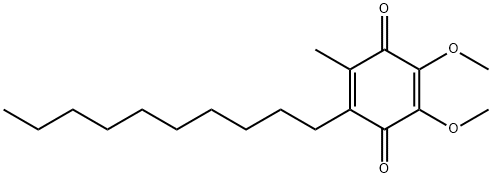
| Product Name: | DECYLUBIQUINONE | | Synonyms: | 2,3-DIMETHOXY-5-METHYL-6-DECYL-1,4-BENZOQUINONE;6-decylubiquinone;2-decyl-5,6-dimethoxy-3-methylcyclohexa-2,5-diene-1,4-dione;Decylubiquinone (2,3-Dmdb);DECYLUBIQUINONE;2,5-Cyclohexadiene-1,4-dione, 2-decyl-5,6-dimethoxy-3-methyl- | | CAS: | 55486-00-5 | | MF: | C19H30O4 | | MW: | 322.44 | | EINECS: | | Product Categories: | | Mol File: | 55486-00-5.mol |
| DECYLUBIQUINONE Chemical Properties |
| Boiling point | 452.9±45.0 °C(Predicted) | | density | 1.02±0.1 g/cm3(Predicted) | | storage temp. | -20°C | | solubility | Soluble in DMSO (up to 10 mg/ml) | | form | Neat yellow to orange colored oil. | | color | Yellow or orange | | Stability: | Stable for 1 year from date of purchase as supplied. Solutions in DMSO may be stored at -20°C for up to 1 month. |
| Hazard Codes | Xi | | Risk Statements | 36/37/38 | | Safety Statements | 26-36 | | WGK Germany | 3 |
| DECYLUBIQUINONE Usage And Synthesis |
| Description | Decylubiquinone (55486-00-5) inhibits the Ca2+?dependent mitochondrial permeability transition pore (MPTP) without inhibiting respiration.1?Maximum effect on Ca2+?retention capacity of rat liver mitochondria at 100 μM. Inhibits etoposide-induced apoptosis in in L929 cells at 5 μM via inhibition of cytochrome C release.2?Delays rotenone-induced cardiac dysfunction in a zebrafish model of development and cardiovascular function.3?Substrate for various quinone oxidoreductases.4,5 | | Uses | Decylubiquinone is inhibits the Ca2+-dependent mitochondrial permeability transition pore (MPTP) and also inhibits etoposide-induced apoptosis. | | General Description | Ubiquinone analog. | | References | 1) Fontaine?et al. (1998),?A Ubiquinone-binding Site Regulates the Mitochondrial Permeability Transition Pore; J. Biol. Chem.,?273?25734
2) Karpinich?et al. (2002),?The course of Etoposide-Induced Apoptosis from Damage to DNA and p53 Activation to Mitochondrial Release of Cytochrome c; J. Biol. Chem.,?277?16547
3) Pinho?et al. (2013)?How mitochondrial dysfunction affects zebrafish development and cardiovascular function: an in vivo model for testing mitochondria-targeted drugs; Br. J. Pharmacol.,?169?1072
4) Kunow?et al.?(1994)?F420H2: quinone oxidoreductase from Archaeoglobus fulgidus. Characterization of a membrane-bound multisubunit complex containing FAD and iron-sulfur clusters; Eur. J. Biochem.,?223?503
5) Zickermann?et al?(1998)?Analysis of the pathogenic human mitochondria mutation ND1/3460 and mutations of strictly conserved residues in it’s vicinity, using the bacterium Paracoccis denitrificans; Biochemistry,?37?11792 |
| DECYLUBIQUINONE Preparation Products And Raw materials |
|


 日本语
日本语 한국어
한국어 Français
 Deutsch
 España
 Türkiye