Other grades of this product :
| COENZYME A SODIUM SALT Basic information |
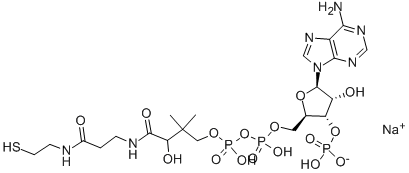
| Product Name: | COENZYME A SODIUM SALT | | Synonyms: | CoenzymeA hydrate sodium salt;coenzyme A sodium from yeast;COENZYME A, SODIUM CELL CULTURE TESTED;COENZYME A DISODIUM SALT;COENZYME A SODIUM SALT;COENZYME A SODIUM SALT HYDRATE;COENZYME A TRISODIUM SALT;COA NA2 | | CAS: | 55672-92-9 | | MF: | C21H35N7NaO16P3S | | MW: | 789.52 | | EINECS: | 259-747-8 | | Product Categories: | | Mol File: | 55672-92-9.mol |
| COENZYME A SODIUM SALT Chemical Properties |
| storage temp. | −20°C | | solubility | H2O: soluble50mg/mL, clear, colorless to faintly yellow |
| COENZYME A SODIUM SALT Usage And Synthesis |
| Uses | Coenzyme A is suitable for use in:- gylcerolipid biosynthesis in porcine adipose tissue
- an assay to measure the level of Alpha-methylacyl-CoA racemase (AMACR) in human blood samples using a nanoparticle electrochemical biosensor
- chloramphenicol acetyltransferase (CAT) assay
- the synthesis of palmitoyl-CoA, which is required for palmitoylation and activation of proteins for regulated membrane fusion
| | General Description | Coenzyme A (CoA) is an essential cofactor in living systems and is synthesized from pantothenic acid (vitamin B5), The CoA levels in mitochondria and peroxisomes correspond to 2-5 mM and 0.7 mM, respectively. Cytosolic CoA is in the range of 0.05 mM to 0.14 mM | | Biochem/physiol Actions | Coenzyme A (CoA, CoASH, HSCoA) is a coenzyme that facilitates enzymatic acyl-group transfer reactions and supports the synthesis and oxidation of fatty acids. CoA is involved in the mechanisms of a wide variety of enzymes. In the presence of CoASH, organic carboxylic acids form acyl-CoA thioesters, which facilitates enzyme recognition. The acyl-CoA formed from xenobiotic carboxylic acids can add to the compound′s toxicity, which can lead to cellular metabolic dysfunction. It is involved in the oxidation of pyruvate in the Kreb′s cycle. CoA is needed for metabolic events. The bacterial CoA pathway is targeted for antimicrobial development. It mediates acyl group transfer and carbonyl activation. The CoA and its thioester levels are crucial for cellular homeostasis. CoA is also involved in regulating platelet aggregation and vasoconstriction. It acts as an essential cofactor in enzymatic acetyl transfer reactions. |
| COENZYME A SODIUM SALT Preparation Products And Raw materials |
|


 日本语
 한국어
 Français
 Deutsch
 España
 Türkiye