Other grades of this product :
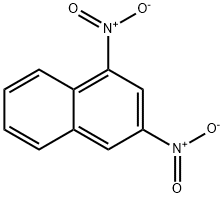
| 1,3-DINITRONAPHTHALENE Basic information |
| 1,3-DINITRONAPHTHALENE Chemical Properties |
| Melting point | 146-148 °C (lit.) | | Boiling point | 358.84°C (rough estimate) | | density | 1.4330 (rough estimate) | | refractive index | 1.5800 (estimate) | | Stability: | Stability Stable, but may be heat or shock sensitive. Incompatible with strong bases, strong oxidizing agents. | | EPA Substance Registry System | 1,3-Dinitronaphthalene (606-37-1) |
| Hazard Codes | Xi | | Risk Statements | 36/37/38 | | Safety Statements | 26-37/39 | | RIDADR | 2811 | | WGK Germany | 3 | | RTECS | QJ4550800 | | HazardClass | 6.1(b) | | PackingGroup | III |
| 1,3-DINITRONAPHTHALENE Usage And Synthesis |
| Chemical Properties | beige powder | | Uses | 1,3-Dinitronaphthalene was used to study the photocatalytic oxidation reaction of 1,3-dinitronaphthalene in the presence of TiO(2) Degussa (P-25 grade). | | Synthesis Reference(s) | Journal of the American Chemical Society, 71, p. 2855, 1949 DOI: 10.1021/ja01176a078 | | General Description | Beige powder. | | Air & Water Reactions | Insoluble in water. | | Reactivity Profile | 1,3-DINITRONAPHTHALENE may be sensitive to heat or shock. | | Fire Hazard | Flash point data are not available for 1,3-DINITRONAPHTHALENE, but 1,3-DINITRONAPHTHALENE is probably combustible. | | Safety Profile | Suspected carcinogen.
Mutation data reported. When heated to
decomposition it emits toxic vapors of NOx |
| 1,3-DINITRONAPHTHALENE Preparation Products And Raw materials |
|


 日本语
日本语 한국어
한국어 Français
 Deutsch
 España
 Türkiye