Other grades of this product :
| cinnabarinic acid Basic information |
| cinnabarinic acid Chemical Properties |
| Melting point | >300°C | | density | 1.79 | | storage temp. | 2-8°C | | solubility | DMSO: ≥4mg/mL | | form | powder | | color | red to very dark red | | Stability: | Stable for 2 years from date of purchase as supplied. Solutions in DMSO or DMF may be stored at -20°C for up to 1 month. |
| cinnabarinic acid Usage And Synthesis |
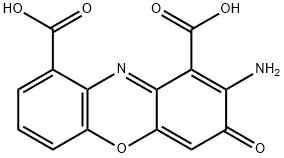
| Description | Cinnabarinic acid is a phenoxazinone produced by the oxidative dimerization of 3-hydroxyanthranilic acid (3-HAA) as part of the metabolism of tryptophan in the kynurenic pathway. It acts as a partial receptor agonist of the metabotropic glutamate receptor 4 (mGlu4), effective at 100 μM, with no activity at other mGlu receptor subtypes. 3-HAA does not affect mGlu receptors, including mGlu4. Cinnabarinic acid induces apoptosis of T cells at 300-500 μM, a potency some ten times that of 3-HAA. | | Chemical Properties | Dark Red Solid | | Uses | A natural phenoxazinone deriv
Cin
nabarinic acid strongly induces apoptosis in thymocytes through the generation of reactive oxygen species and the induction of caspase. | | Uses | A natural phenoxazinone derivative, Cinnabarinic acid is obtained in vitro with aid of laccase by oxidative dimerization of 3-Hydroxyanthranilic acid (a metabolite of the amino acid Trytophan). Cinnabarinic acid strongly induces apoptosis in thymocytes through the generation of reactive oxygen species and the induction of caspase. | | Uses | Cinnabarinic acid may be used in studies of the functions of components of the kynurenine metabolic pathway. It may be used to study it role as a metabotropic glutamate receptor (mGlu4R-specific) agonist. | | Biochem/physiol Actions | Cinnabarinic acid is a kynurenine pathway metabolite of tryptophan, produced by the oxidation of 3-Hydroxyanthranilic acid. Cinnabarinic acid leads to loss of mitochondrial respiration and apoptosis, and has also been shown to be an mGlu4R-specific agonist. | | References | 1) Lowe?et al.?(2014),?Identification of cinnabarinic acid as a novel endogenous aryl hydrocarbon receptor ligand that drives IL-22 production;? PLoS One,?9(2)?e87877
2) Hiramatsu?et al. (2008),?Cinnabarinic acid generated from 3-hydroxyanthranilic acid strongly induces apoptosis in thymocytes through the generation of reactive oxygen species and the induction of caspase;? J. Cell. Biochem.,?103?42
3) Fazio?et al.?(2012),?Cinnabarinic acid, an endogenous metabolite of the kynurenine pathway, activates type 4 metabotropic glutamate receptors;? Mol. Pharmacol.,?81?643 |
| cinnabarinic acid Preparation Products And Raw materials |
|


 日本语
日本语 한국어
한국어 Français
 Deutsch
 España
 Türkiye