Other grades of this product :
| 6-pentadecylsalicylic acid Basic information |
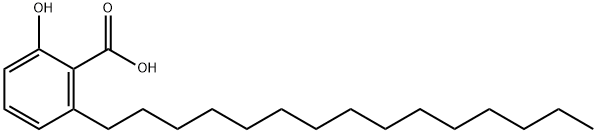
| Product Name: | 6-pentadecylsalicylic acid | | Synonyms: | NSC 333857;NSC 623096;Anachardic acid;(15:0)-Anacardic acid;Ginkgolic Acid 15:0 〔Anacardic Acid 15:0〕;Hodrogenated anacardic acid;PENTADECYLSALICYLICACID;6-Pentadecyl-2-hydroxybenzoic acid | | CAS: | 16611-84-0 | | MF: | C22H36O3 | | MW: | 348.52 | | EINECS: | | Product Categories: | Inhibitors | | Mol File: | 16611-84-0.mol |
| 6-pentadecylsalicylic acid Chemical Properties |
| Melting point | 90-91℃ | | Boiling point | 474.8±33.0 °C(Predicted) | | density | 1.002 | | storage temp. | -20°C | | solubility | DMSO: ≥20mg/mL | | form | White solid | | pka | 3.08±0.30(Predicted) | | color | white to beige | | Stability: | Stable for 1 year from date of purchase as supplied. Solutions in DMSO or ethanol may be stored at -20°C for up to 3 months. | | InChIKey | ADFWQBGTDJIESE-UHFFFAOYSA-N |
| Hazard Codes | Xi | | Risk Statements | 36 | | Safety Statements | 26 | | WGK Germany | 3 |
| 6-pentadecylsalicylic acid Usage And Synthesis |
| Description | Anacardic acid, isolated from cashew shells or several other medicinal plants, is the general name given to a family of four different 6-alkyl salicyclic acids having varying degrees of unsaturation in the 15-carbon alkyl chain. These compounds are associated with anti-inflammatory, anti-tumor, molluscicidal, and anti-microbial activity. Literature frequently sites and gives the name anacardic acid to the completely-saturated compound (6-pentadecyl salicylic acid). Anacardic acid inhibits the histone acetyltransferase (HAT) activity of the transcription co-activators p300 and p300/CREB-binding protein-associated factor (PCAF) with IC50 values of 8.5 and 5 μM, respectively. At 25 μmol/L, anacardic acid suppresses NF-κB activation, inhibits IκB-α phosphorylation, and prohibits p65 nuclear translocation in KBM-5 cells. | | Uses | Anacardic acid has been used: - as a histone acetylase (HAT) inhibitor to study its effects on rat cortical neurons
- as a positive control in acetylation assay in vitro
- as an acetylase inhibitor to study its effects on the ribonucleic acid export 1 (Rae-1) protein acetylation that was transfected in human embryonic kidney cells
| | Uses | Anacardic acid, isolated from cashew shells or several other medicinal plants, is the general name given to a family of four different 6-alkyl salicyclic acids having varying degrees of unsaturation in the 15-carbon alkyl chain. These compounds are associated with anti-inflammatory, anti-tumor, molluscicidal, and anti-microbial activity. Literature frequently sites and gives the name anacardic acid to the completely-saturated compound (6-pentadecyl salicylic acid). Anacardic acid inhibits the histone acetyltransferase (HAT) activity of the transcription co-activators p300 and p300/CREB-binding protein-associated factor (PCAF) with IC50 values of 8.5 and 5 μM, respectively. At 25 μmol/L, anacardic acid suppresses NF-κB activation, inhibits IκB-α phosphorylation, and prohibits p65 nuclear translocation in KBM-5 cells.[Cayman Chemical] | | Uses | 2-Hydroxy-6-pentadecyl Benzoic Acid, is a compound that is used to treat agriculture from various fruit insects. Derivative of this molecule has been also shown to be a potent activator of human 5-lipoxygenases (5-LOX). | | General Description | A cell-permeable ginkgolic acid (Cat. No. 345887) analog that inhibits protein SUMO (Cat. Nos. 662037, 662039, and 662042) modification (IC50 = 2.2 μM using RanGAP1-C2 as substrate) in an ATP-dependent manner by selectively targeting SUMO-activating enzyme E1 (Cat. Nos. 662073 and 662074) and interfering with E1-SUMO intermediate formation. Both anacardic acid and ginkgolic acid are shown to effectively decrease overall SUMOylation of 293T cellular proteins in a dose-dependent manner, while neither compound is effective in affecting overall cellular protein ubiquitination or histone H4K8 acetylation in 293T cultures, although anacardic acid is shown to inhibit p300 (Cat. No. 506200) and PCAF (Cat. No. 124026) histone acetyltransferase activities in cell-free acetylase assays (by 82% and 86%, respectively, at 10 μM). Also reported to inhibit the activity of prostaglandin synthase, tyrosinase, and lipoxygenase, as well as to enhance Aurora kinase A (Cat. No. 481413), but not Aurora kinase B, autophosphorylation and kinase activity by inducing conformation change and enhancing ATP binding. | | Biochem/physiol Actions | Target IC50: 5 μM against HAT; 8.5 μM against PCAF; 2.2 μM inhibiting protein SUMO modification using RanGAP1-C2 as substrate | | in vitro | lncap, a classical metastatic prostate adenocarcinoma cell line, was adopted to study the effect of aa on cell growth, cycles and apoptosis. it was found that 125 m aa significantly inhibited lncap cell proliferation. in addition, the g1/s cell cycles arrest and the apoptosis of lncap cell was induced. further mechanistic study suggested that aa induced cell apoptosis via suppressing p300. [1] | | in vivo | diesel exhaust particle- (dep-) induced lung inflammation model was established to study the effect of aa on inflammation in mice. ten days before dep-instillation stimulation, mice were orally pretreated with 50, 150, or 250 mg/kg of aa for thirty days. all doses of aa ameliorated activities of oxidative enzymes. moreover, 50 mg/kg of aa significantly decreased the expression level of tumor necrosis factor in lung. [2] | | IC 50 | noncompetitively inhibit histone acetyltransferase (hat) activity in prostate cancer with an ic50 value of about 5.0 m. | | References | 1) Balasubramanyam et al. (2003), Small molecule modulators of histone acetyltransferase p300; J. Biol. Chem. 278 19134
2) Sun et al. (2006), Inhibition of histone acetyltransferase activity by anacardic acid sensitizes tumor cells to ionizing radiation; FEBS Lett. 580 4353
3) Wu et al. (2011), Anacardic acid (6-Pentadecylsalicylic acid) Inhibits Tumor Angiogenesis by Targeting Src/FAK/Rho GTPases Signaling Pathway; J. Pharmacol. Exp. Ther. 339 403
4) Omanakuttan et al. (2012), Anacardic acid Inhibits the Catalytic Activity of Matrix Metalloproteinase-2 and Matrix Metalloproteinase-9; Mol. Pharmacol. 82 614
5) Sung et al. (2008), Anacardic acid (6-nonadecyl salicylic acid), an inhibitor of histone acetyltransferase, suppresses expression of nuclear factor-kB- regulated gene products involved in cell survival, proliferation, invasion, and inflammation through inhibition of the inhibitory subunit of nuclear factor-kBα kinase, leading to potentiation of apoptosis; Blood 111 4880 |
| 6-pentadecylsalicylic acid Preparation Products And Raw materials |
|


 日本语
日本语 한국어
한국어 Français
 Deutsch
 España
 Türkiye