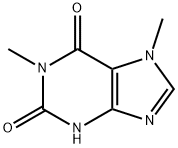
| 1,7-DIMETHYLXANTHINE Basic information |
| Product Name: | 1,7-DIMETHYLXANTHINE |
| Synonyms: | 1,7-Dimethyl-1H-purine-2,6-dione, 1,7-Dimethylxanthine, 2,6-Dihydroxy-1,7-dimethylpurine, Paraxanthine;1,7-dimethyl-3H-purine-2,6-dione;Caffeine Impurity F(EP);Caffeine Impurity 6(Caffeine EP Impurity F);1,7-Dimethyl-1H-purine-2,6-dione, 2,6-Dihydroxy-1,7-dimethylpurine, Paraxanthine;1,7-Dimethyl-2,3,6,7-tetrahydro-1H-purine-2,6-dione;1,7-Dimethylxanthine-[13C4,15N3] (para-xanthine);1,7-Dimethylxanthine-[2H6] (para-xanthine) |
| CAS: | 611-59-6 |
| MF: | C7H8N4O2 |
| MW: | 180.16 |
| EINECS: | 210-271-9 |
| Product Categories: | Isolabel;Amines;Various Metabolites and Impurities;Heterocycles;Metabolites & Impurities;Phosphorylating and Phosphitylating Agents;Metabolites |
| Mol File: | 611-59-6.mol |
| 1,7-DIMETHYLXANTHINE Chemical Properties |
| Melting point | 294-296 °C (lit.) |
| Boiling point | 312.97°C (rough estimate) |
| density | 1.3640 (rough estimate) |
| refractive index | 1.6700 (estimate) |
| Fp | 9℃ |
| storage temp. | room temp |
| solubility | ethanol: 0.6mg/mL |
| form | solid |
| pka | pKa 8.5 (Uncertain) |
| color | white |
| BRN | 197907 |
| Stability: | Store tightly sealed at RT |
| EPA Substance Registry System | 1H-Purine-2,6-dione, 3,7-dihydro-1,7-dimethyl- (611-59-6) |
| Safety Information |
| Hazard Codes | Xn,T,F |
| Risk Statements | 22-39/23/24/25-23/24/25-11 |
| Safety Statements | 22-24/25-45-36/37-16-7 |
| RIDADR | UN1230 - class 3 - PG 2 - Methanol, solution |
| WGK Germany | 3 |
| RTECS | RV9380000 |
| Toxicity | mmo-esc 150 mg/L CSHSAZ 16,337,52 |
| MSDS Information |
| Provider | Language |
|---|---|
| SigmaAldrich | English |
| 1,7-DIMETHYLXANTHINE Usage And Synthesis |
| Description | Paraxanthine is an inhibitor of phosphodiesterase 9 (PDE9) and an antagonist of adenosine receptors A1 and A2 (Kis = 35 and 22 μM, respectively in equine forebrain tissues). It is the main metabolite of caffeine in humans, making up 80% of the three dimethylxanthine metabolites produced by caffeine demethylation. Paraxanthine increases locomotor activity and counteracts adenosine receptor agonist-induced motor depression in rats not habituated to caffeine. At a dose of 30 mg/kg, paraxanthine induces a significant increase in striatal cGMP and extracellular striatal dopamine concentrations in vivo. It also promotes wakefulness and increases locomotor activity and core temperature in narcoleptic transgenic mice without increasing behavioral anxiety. |
| Chemical Properties | Off-White to Pale Yellow Solid |
| Uses | An adenosine receptor ligand and a major metabolite of caffeine |
| Uses | adenosine receptor agonist, CNS stimulant |
| Uses | 1,7-Dimethylxanthine has been used for the quantification of caffeine by high-performance liquid chromatography (HPLC). |
| Uses | Paraxanthine is an adenosine receptor ligand and a major metabolite of caffeine.This compound is a contaminant of emerging concern (CECs). |
| General Description | Paraxanthine is a major plasma and urinary metabolite of caffeine. This xanthine derivative is, along with caffeine, a central nervous system stimulant. This Snap-N-Spike? reference solution is applicable for caffeine quantitation in clinical toxicology or urine drug testing by LC-MS/MS or GC/MS. |
| Biochem/physiol Actions | Adenosine receptor ligand; major metabolite of caffeine |
| Safety Profile | An experimental teratogen. Mutation data reported. Whenheated to decomposition it emits toxic fumes of NOx. |
| 1,7-DIMETHYLXANTHINE Preparation Products And Raw materials |
| Preparation Products | Theophylline |
Please leave a message for us or use the following ways to contact us, we will reply to you as soon as possible, and provide you with the most sincere service, thank you.


 日本语
日本语 한국어
한국어 Français
 Deutsch
 España
 Türkiye