Other grades of this product :
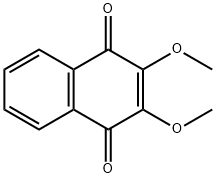
| Product Name: | DMNQ | | Synonyms: | DMNQ;DIMENQ;2,3-DIMETHOXY-1,4-NAPHTHOQUINONE;RARECHEM BW GA 0209;1,4-Naphthalenedione, 2,3-dimethoxy-;Nsc 69355;2,3-dimethoxynaphthalene-1,4-dione;2,3-Dimethoxy-1,4-naphthalenedione | | CAS: | 6956-96-3 | | MF: | C12H10O4 | | MW: | 218.21 | | EINECS: | 604-604-1 | | Product Categories: | | Mol File: | 6956-96-3.mol |
| storage temp. | -20°C | | solubility | Soluble in DMSO (up to 10 mg/ml) or in Ethanol (up to 5 mg/ml). | | form | solid | | color | Yellow | | Stability: | Stable for 1 year as supplied. Solutions in DMSO may be stored at -20° for up to 3 months. |
| Hazard Codes | Xi | | Risk Statements | 36/37/38 | | Safety Statements | 26-36 | | WGK Germany | 3 |
| Description | DMNQ is a 1,4-naphthoquinone that acts as a redox-cycling agent, typically increasing intracellular superoxide and hydrogen peroxide formation. The amount of oxidative stress is proportional to the amount of DMNQ applied and can alter diverse cellular parameters, including signal transduction, mitochondrial function, and gene expression. | | Uses | DMNQ is a non-alkylating redox cycling quinone. | | Uses | 2,3-Dimethoxy-1,4-naphthoquinone has been used to investigate the effects of ethanol on podocyte apoptosis under hypoxic and hyperoxic conditions. | | Definition | ChEBI: A naphthoquinone that is 1,4-naphthoquinone bearing two methoxy substituents at positions 2 and 3. Redox-cycling agent that induces intracellular superoxide anion formation and, depending on the concentration, induces cell proliferation, apoptosis or necro
is. Used to study the role of ROS in cell toxicity, apoptosis, and necrosis. | | Biochem/physiol Actions | 2,3-dimethoxy-1,4-naphthoquinone (DMNQ) has the ability to produce H2O2?through redox cycling but fails to conjugate with glutathione (GSH). | | References | References/Citations
1) Gant?et al. (1988)?Redox Cycling and Sulphydryl Arylation; Their Relative Importance in the Mechanism of Quinone Cytotoxicity to Isolated Hepatocytes; Chem. Biol. Interactions;?65?157
2) Stubberfield and Cohen (1989)?Interconversion of NAD(H) to NADP(H). A cellular response to quinone-induced oxidative stress in isolated hepatocytes; Biochem. Pharmacol.,?38?2631
3) Dypbukt?et al?(1994)?Different prooxidant levels stimulate growth, trigger apoptosis or produce necreosis of insulin-secreting RINm5F cells. The role of intracellular polyamines; J. Biol. Chem.,?269?30553
4) Henry and Wallace (1996)?Differential mechanisms of cell killing by redox cycling and arylating quinones; Arch. Toxicol.,?70?482 |
| DMNQ Preparation Products And Raw materials |
|


 日本语
日本语 한국어
한국어 Français
 Deutsch
 España
 Türkiye