Other grades of this product :
| (R)-BUTAPROST Basic information |
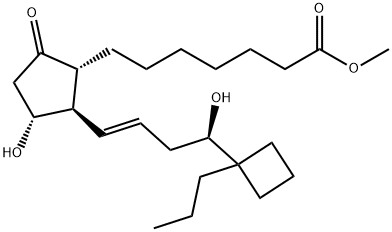
| Product Name: | (R)-BUTAPROST | | Synonyms: | BAY-q-4218;(1r,2r,3r)-3-hydroxy-2-[(1e,4r)-4-hydroxy-4-(1-propylcyclobutyl)-1-butenyl]-5-oxo-cyclopentaneheptanoic acid methyl ester;(1R)-3α-Hydroxy-2β-[(1E,4R)-4-hydroxy-4-(1-propylcyclobutan-1-yl)-1-butenyl]-5-oxocyclopentaneheptanoic acid methyl ester;Cyclopentaneheptanoic acid, 3-hydroxy-2-[(1E,4R)-4-hydroxy-4-(1-propylcyclobutyl)-1-buten-1-yl]-5-oxo-, methyl ester, (1R,2R,3R)-;Butaprostum | | CAS: | 69648-38-0 | | MF: | C24H40O5 | | MW: | 408.57 | | EINECS: | | Product Categories: | | Mol File: | 69648-38-0.mol |
| (R)-BUTAPROST Chemical Properties |
| storage temp. | -20°C | | solubility | DMSO: freely soluble | | form | oil | | color | light yellow |
| (R)-BUTAPROST Usage And Synthesis |
| Description | Butaprost is a structural analog of prostaglandin E2 (PGE2) with good selectivity for the EP2 receptor subtype. Butaprost has frequently been used to pharmacologically define the EP receptor expression profile of various human and animal tissues and cells. Serious confusion as to the structure of butaprost was generated by Gardiner in 1986, when he reported that the epimer of butaprost showing this selective activity was the C-16 (R)-epimer (See reference and Note). Butaprost binds with about 1/10 the affinity of PGE2 to the recombinant murine EP2 receptor, and does not bind appreciably to any of the other murine EP receptors or DP, FP, IP, or TP receptors. The pharmacology of (R)-butaprost has not been carefully studied, but it is generally considered to be the less active epimer. (NOTE: In the Gardiner paper in the 1986 British Journal of Pharmacology, butaprost appears on page 46 where it is given the name TR 4979. The structure as drawn is incorrect, in that the author was using and referring to the more active C-16 epimer, which is actually 16(S). The structure on page 46 shows the structure as 16(R). It was not until the late 1990’s that careful studies both in the US and Japan correctly identified the actual configuration of C-16 in the compound called butaprost is 16(S).) | | Uses | (R)-Butaprost has been used as a prostanoid receptor (EP)-specific agonist to study its effects on protein kinase A (PKA) regulatory subunits in MCF7 cells. It may be used as EP2 agonist in Madin-Darby canine kidney and mouse cortical collecting duct (mpkCCD14) cells. It may also be used as EP2 agonist in human fetal lung fibroblasts (HFL-1) cells to test its effect on vascular endothelial growth factor (VEGF) production. | | Uses | Bronchodilator. | | Biochem/physiol Actions | Butaprost comprises hydroxy-cyclopentanone ring and ω-chain. It aids protection in events of glutamate based N-methyl-D-aspartate receptor toxicity. Butaprost inhibits conjunctival fibrosis and lowers the intraocular pressure in post glaucoma filtration surgery. It also promotes wound healing by reducing the subconjunctival scarring Tenon′s fibroblasts. Butaprost plays a protective role in pulmonary fibrosis and aids protection against the aggregated amyloid β (Aβ) peptides in Alzheimer′s disease. |
| (R)-BUTAPROST Preparation Products And Raw materials |
|


 日本语
日本语 한국어
한국어 Français
 Deutsch
 España
 Türkiye