Other grades of this product :
| BORRELIDIN Basic information |
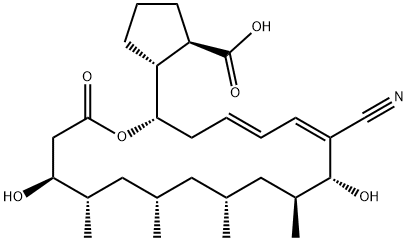
| Product Name: | BORRELIDIN | | Synonyms: | 2-(7-CYANO-8,16-DIHYDROXY-9,11,13,15-TETRAMETHYL-18-OXOOXACYCLOOCTADECA-4,6-DIEN-2-YL)-CYCLOPENTANECARBOXYLIC ACID;BORRELIDIN;BORRELIDINE;2-(7-Cyano-8,16-dihydroxy-9,11,13,15-tetramethyl-18-oxo-1-oxacyclooctadeca-4,6-dien-2-yl)cyclopentane-1-carboxylic acid;Aids128115;Aids-128115;Cyclopentanecarboxylic acid, 2-(7-cyano-8, 16-dihydroxy-9,11,13,15-tetramethyl-18-oxooxacyclooctadeca-4, 6-dien-2-yl)-;Quinquangulin K 031 | | CAS: | 7184-60-3 | | MF: | C28H43NO6 | | MW: | 489.64 | | EINECS: | | Product Categories: | | Mol File: | 7184-60-3.mol |
| BORRELIDIN Chemical Properties |
| Melting point | 143-145℃ | | Boiling point | 584.45°C (rough estimate) | | density | 1.1362 (rough estimate) | | refractive index | 1.6290 (estimate) | | storage temp. | −20°C | | solubility | DMSO: 1 mg/mL | | form | White to off-white powder. | | pka | 4.56±0.40(Predicted) | | color | Off-white | | Stability: | Stable for 2 years from date of purchase as supplied. Solutions in DMSO or ethanol may be stored at -20° for up to 3 months. |
| Safety Statements | 24/25 | | WGK Germany | 3 | | RTECS | ED8750000 | | HS Code | 29419090 |
| BORRELIDIN Usage And Synthesis |
| Description | Borrelidin (7184-60-3) ia a novel macrolide which inhibits bacterial and eukaryotic threonyl-tRNA synthetase.1 Displays potent anti-angiogenic activity (IC50=0.8 nM) and induces the collapse of newly formed capillary tubules.2 Modulates alternative splicing of VEGF in favor of anti-angiogenic isoforms.3 Induces apoptosis in ALL cell lines.4 Induces unfolded protein response in oral cancer cells.5 Cell permeable. | | Uses | Borrelidin is an unusual nitrile-containing metabolite isolated from Streptomyces. Originally discovered as active against Borrelia species, borrelidin has since found a role as a selective inhibitor of bacterial and eukaryal threonyl-tRNA synthetase. More recent research has found that borrelidin is a very potent angiogenesis inhibitor and induces apoptosis of the capillary tube-forming cells. Borrelidin is an important lead for antimalarial discovery, displaying activity against drug-resistant Plasmodia. | | Uses | Borrelidin is a secondary metabolite produced by Streptomyces and other bacteria. It displays potent antiangiogenic activity, preventing tube formation in rat aorta explants (IC50 = 0.8 nM) and inducing apoptosis in endothelial cells. Borrelidin also alters the splicing of VEGF mRNA, producing an antiangiogenic isoform of the growth factor. It has long been known as a powerful inhibitor of both eukaryotic and bacterial threonyl tRNA synthetase. Borrelidin is also an effective anti-malarial drug, as it kills P. falciparum with an IC50 value of 1.8 nM. At higher doses, it inhibits cyclin-dependent kinase in yeast (IC50 = 24 μM), resulting in growth arrest in the G1 phase. | | Definition | ChEBI: A macrolide that is isolated from several Streptomyces species and displays antibiotic, antineoplastic and antimalarial properties. | | General Description | Chemical structure: macrolide | | Biochem/physiol Actions | Borrelidin is a potent angiogenesis inhibitor that induces apoptosis in capillary tube-forming cells. Also displays antimalarial activity against drug-resistant Plasmodia. Antimicrobial and selective threonyl t-RNA synthetase inhibitor. | | References | References/Citations
1) Ruan et al. (2005), A unique hydrophobic cluster near the active site contributes to differences in borrelidin inhibition among threonyl-tRNA synthetases; J. Biol. Chem., 280 571
2) Kawamura et al. (2003), Anti-angiogenesis effects of borrelidin are mediated through distinct pathways: threonyl-tRNA synthase and caspases are independently involved in suppression of proliferation and induction of apoptosis in endothelial cells; J. Antibiot., 56 709
3) Woolard et al. (2011) Borrelidin modulates the alternative splicing of VEGF in favour of anti-angiogenic isoforms; Chem. Soc. 2011 273
4) Habibi et al. (2012), Borrelidin, a small molecule nitrile-containing macrolide inhibitor of threonyl-tRNA synthase, is a potent inducer of apoptosis in acute lymphoblastic leukemia; Invest. New Drugs, 30 1361
5) Sidhu et al. (2015), Borrelidin Induces the Unfolded Protein Response in Oral Cancer Cells and Chop-Dependent Apoptosis; ACS Med. Chem. Lett., 6 1122 |
| BORRELIDIN Preparation Products And Raw materials |
| Raw materials | Cyclopentanecarboxylic acid, 2-[(2S,4E,6Z,8R,9S,11R,13S,15S,16S)-7-cyano-8,16-dihydroxy-9,11, 13,15-tetramethyl-18-oxooxacyclooctadeca-4,6-dien-2-yl]-, 2-(trimethylsilyl)ethyl ester, (1R,2R)--->1,2-Cyclopentanedicarboxylic acid, 1,2-dimethyl ester, (1R,2R)--->1-Pentanol, 5-[[(1,1-dimethylethyl)dimethylsilyl]oxy]-2,4-dimethyl-, (2S,4R)--->(1R,2R)-1,2-Cyclopentanedimethanol-->1,2-Cyclopentanedicarboxylic acid, 4-oxo-, 1,2-diMethyl ester, (1R,2R)- |
|


 日本语
 한국어
 Français
 Deutsch
 España
 Türkiye