Other grades of this product :
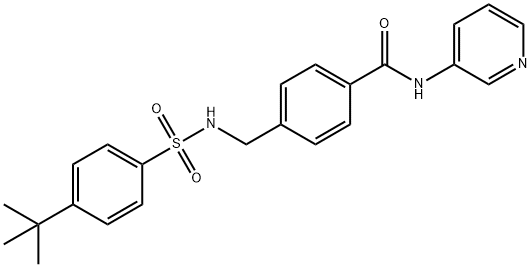
| Product Name: | STF 31 | | Synonyms: | STF 31;4-[[[[4-(1,1-Dimethylethyl)phenyl]sulfonyl]amino]methyl]-N-3-pyridinyl-benzamide;N'-(4-METHYLPHENYL)-4-PYRIDINECARBOXIMIDAMIDE; 4-[[(4-tert-butylphenyl)sulfonylamino]methyl]-N-pyridin-3-ylbenzamide;STF31;STF 31;CS-1575;Benzamide, 4-[[[[4-(1,1-dimethylethyl)phenyl]sulfonyl]amino]methyl]-N-3-pyridinyl-;4-((4-(tert-Butyl)phenylsulfonamido)methyl)-N-(pyridin-3-yl)benzamide | | CAS: | 724741-75-7 | | MF: | C23H25N3O3S | | MW: | 423.53 | | EINECS: | 809-820-0 | | Product Categories: | Inhibitors;API | | Mol File: | 724741-75-7.mol |
| STF 31 Chemical Properties |
| density | 1.247±0.06 g/cm3(Predicted) | | storage temp. | -20°C | | solubility | DMSO: soluble20mg/mL, clear | | pka | 11.28±0.50(Predicted) | | form | powder | | color | white to beige | | Stability: | Stable for 1 year from date of purchase as supplied. Solutions in DMSO may be stored at -20° for up to 1 month. |
| Hazard Codes | Xn | | Risk Statements | 22 | | Safety Statements | 46 | | WGK Germany | 3 |
| STF 31 Usage And Synthesis |
| Description | Glucose transporter 1 (Glut1) is an inducible carrier of pentoses and hexoses, including glucose. STF-31 is an inhibitor of Glut1 (IC50 = ~1 μM) that blocks glucose uptake. It induces necrosis in cancer cells that lack the von Hippel-Lindau tumor suppressor gene, which overexpress Glut1. Although STF-31 binds Glut1, suggesting a direct effect, STF-31 also inhibits nicotinamide phosphoribosyltransferase, an enzyme that induces Glut1 expression. STF-31 is also toxic to human pluripotent stem cells (hPSCs) and can be used to selectively eliminate hPSCs from mixed cultures. | | Uses | STF 31 is used in biological studies as pyridylanilinothiazoles and pyridylphenylsulfonyl benzamides scaffolds use to prepare affinity chromatoraphy reagents for cancer targeting. STF 31 is an inhibitor of GLUT1 which blocks glucose uptake. | | Biochem/physiol Actions | STF-31 selectively inhibits the glucose transporter GLUT1 and selectively impairs cancer cell growth of kidney and other types of cancer cells that lack the von Hippel-Lindau (VHL) tumor suppressor protein. Inactivation of VHL increases the activity of hypoxia-inducible factor transcription factor HIF, which in turn stimulates the transcription of genes involved in glucose metabolism, including the GLUT1 gene. VHL-deficient cancer cells, which include about 80% of renal cell carcinomas, are dependent on the high affinity GLUT1 transporter and aerobic glycolysis for ATP production. STF-31 binds directly to the GLUT1 transporter, blocking glucose uptake, resulting in necrosis in VHL-deficient cancer cells, but not in normal cells or cancer cells with intact VHL. | | References | 1) Chan?et al. (2011),?Targeting GLUT1 and the Warburg effect in renal cell carcinoma by chemical synthetic lethality; Sci. Transl. Med.,?3?94ra70
2) Adams?et al., (2014),?NAMPT is the Cellular Target of STF-31-Like Small-Molecule Probes; ACS Chem. Biol.,?9?2447
3) Dragovich?et al. (2014),?Fragment-based design of 3-aminopyridine-derived amides as potent inhibitors of human nicotinamide phosphribosyltransferase (NAMPT); Bioorg. Med. Chem. Lett.,?24?954
4)Kraus?et al.?(2018),?Targeting glucose transport and the NAD pathway in tumor cells with STF-31: a re-evaluation; Cell Oncol.(Dordr)?41?485 |
| STF 31 Preparation Products And Raw materials |
|


 日本语
日本语 한국어
한국어 Français
 Deutsch
 España
 Türkiye