| Description | Ciglitazone (74772-77-3) is a PPARγ agonist (EC50=3 μM). Stimulates adipogenesis in human mesenchymal stem cells. Ciglitazone inhibits HUVEC differentiation and angiogenesis. Cell permeable. |
| Chemical Properties | White Cyrstalline Solid |
| Uses | Displays antihyperglycemic activity in genetically obese mice. It is a selective PPARg agonist |
| Uses | Displays antihyperglycemic activity in genetically obese mice. It is a selective PPARg agonist. |
| Uses | Ciglitizone has been used as a proliferator-activated receptor γ (PPARγ) agonist:- to study its effects on cell proliferation in human melanocytes
- to study its effects on pigmentation and migration of human melanocytes
It also may be used to study its effects on cell cycle and apoptosis in monocytic cells. |
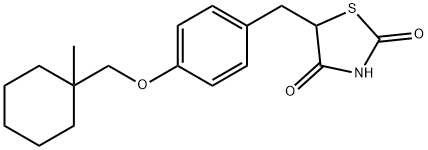
| Definition | ChEBI: An aromatic ether that consists of 1,3-thiazolidine-2,4-dione with position 5 substituted by a 4-[(1-methylcyclohexyl)methoxy]benzyl group. A selective PPARgamma agonist. |
| General Description | A potent thiazolinedione (TDZ) type anti-hyperglycemic agent and a selective PPARγ agonist (EC50 = 3 μM). |
| Biological Activity | Selective agonist at PPAR γ (peroxisome proliferator-activated receptor γ ). Activates PPAR γ with an EC 50 value of 3 μ M in vitro , and is at least 33-fold selective over PPAR α and δ . Antihyperglycemic in vivo . |
| Biochem/physiol Actions | Ciglitizone belongs to the class of thiazolidinediones and is a peroxisome proliferator-activated receptor γ (PPARγ) agonist. It exhibits anti-diabetic activity. Ciglitizone has the potential to treat tumor necrosis factor α (TNFα)-related apoptosis-inducing ligand (TRAIL)-refractory high-grade urothelial cancers. |
| References | 1) Cantello et al. (1994) [[omega-(Heterocyclylamino)alkoxy]benzyl]-2,4-thiazolidinediones as potent antihyperglycemic agents; J. Med. Chem. 37 3977
2) Xin et al. (1999) Peroxisome proliferator-activated receptor gamma ligands are potent inhibitors of angiogenesis in vitro and in vivo; J. Biol. Chem. 274 9116 |


 日本语
日本语 한국어
한국어 Français
 Deutsch
 España
 Türkiye