Other grades of this product :
| 2,5-Dimethyl-2,5-di(tert-butylperoxy)hexane Basic information |
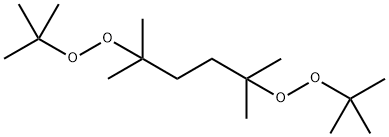
| Product Name: | 2,5-Dimethyl-2,5-di(tert-butylperoxy)hexane | | Synonyms: | Trigonox 101;VAROX DBPH;VAROX DBPH-50;luperox;LUPEROX 101XL;Di-tert-butyl 1,1,4,4-tetramethyltetramethylene diperoxide;2,5-DIMETHYL-2,5-BIS(TERT-BUTYLPEROXY)HEXANE;2,5-DIMETHYL-2,5-DI(T-BUTYL-PEROXY)HEXANE | | CAS: | 78-63-7 | | MF: | C16H34O4 | | MW: | 290.44 | | EINECS: | 201-128-1 | | Product Categories: | Crosslinking agent and initiating agent for silicon rubber, chlorosulfonated polyethylene CSM,polyurethane(PU) and EVA;LUPEROX 101, Trigonox 101;Organics;Crossing agent , DHBP;Trigonox 101,LUPEROX 101,DHBP;Crosslinking agent, 101 | | Mol File: | 78-63-7.mol |
| 2,5-Dimethyl-2,5-di(tert-butylperoxy)hexane Chemical Properties |
| Melting point | 6 °C | | Boiling point | 55-57 °C7 mm Hg(lit.) | | density | 0.877 g/mL at 25 °C(lit.) | | vapor pressure | 0.002Pa at 20℃ | | refractive index | n20/D 1.423(lit.) | | Fp | 149 °F | | storage temp. | 2-8°C | | Water Solubility | immiscible | | Stability: | Unstable. May contain an inhibitor. Incompatible with strong oxidizing agents, acids, reducing agents, organic materials, powdered metals. | | LogP | 7.34 at 20℃ | | CAS DataBase Reference | 78-63-7(CAS DataBase Reference) | | EPA Substance Registry System | 2,5-Dimethyl-2,5-di-(tert-butylperoxy)hexane (78-63-7) |
| 2,5-Dimethyl-2,5-di(tert-butylperoxy)hexane Usage And Synthesis |
| Chemical Properties | colourless to light yellow liquid | | Uses | Polymerization initiator | | Uses | Initiates degradation of polypropylene, monomer scavenger in styrene polymerization. Free radical polymerization initiator. | | General Description | Clear, yellow liquid. also for storage and transport mixed with inert solid. | | Air & Water Reactions | Insoluble in water. | | Reactivity Profile | Peroxides, such as 2,5-DIMETHYL-2,5-DI-(TERT-BUTYLPEROXY)HEXANE, are good oxidizing agents. Organic compounds can ignite on contact with concentrated peroxides. Strongly reduced material such as sulfides, nitrides, and hydrides may react explosively with peroxides. There are few chemical classes that do not at least produce heat when mixed with peroxides. Many produce explosions or generate gases (toxic and nontoxic). Generally, dilute solutions of peroxides (<70%) are safe, but the presence of a catalyst (often a transition metal such as cobalt, iron, manganese, nickel, or vanadium) as an impurity may even then cause rapid decomposition, a buildup of heat, and even an explosion. Solutions of peroxides often become explosive when evaporated to dryness or near-dryness. Danger of explosion when dry. May explode from heat, shock, friction or contamination. May ignite combustibles (wood, paper, oil, clothing, etc.). May be ignited by heat, sparks or flames. | | Flammability and Explosibility | Flammable | | Safety Profile | Moderately toxic by
intraperitoneal route. Combustible when
exposed to heat, flames, or reducing agents.
To fight fire, use water spray, foam, dry
chemical. When heated to decomposition it
emits acrid smoke and irritating fumes. Used
in the polymerization of styrene and in
cross-linking of various grades of
polyethylene. See also PEROXIDES,
ORGANIC. |
| 2,5-Dimethyl-2,5-di(tert-butylperoxy)hexane Preparation Products And Raw materials |
|


 日本语
日本语 한국어
한국어 Français
 Deutsch
 España
 Türkiye