Other grades of this product :
| 4-N-OCTYLPHENOL Basic information |
| 4-N-OCTYLPHENOL Chemical Properties |
| Melting point | 44-45 °C(lit.) | | Boiling point | 150 °C4 mm Hg(lit.) | | density | 0.961 g/mL at 25 °C(lit.) | | RTECS | SM5787000 | | refractive index | 1.5052 (estimate) | | Fp | >230 °F | | storage temp. | room temp | | solubility | Chloroform (Slightly) DMSO (Slightly), Methanol (Slightly) | | form | neat | | pka | 10.15±0.15(Predicted) | | Specific Gravity | 0.961 | | color | White to Dark Beige | | Water Solubility | Insoluble in water. | | Stability: | Stable. Incompatible with strong oxidizing agents. Combustible. | | InChIKey | NTDQQZYCCIDJRK-UHFFFAOYSA-N | | CAS DataBase Reference | 1806-26-4(CAS DataBase Reference) | | EPA Substance Registry System | p-Octylphenol (1806-26-4) |
| 4-N-OCTYLPHENOL Usage And Synthesis |
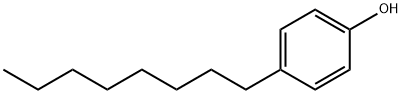
| Chemical Properties | white crystals or powder | | Uses | A weak estrogenic disruptor on the induction of mammary carcinomas (MC) and benign proliferative lesions (PL) induced by DMBA (7,12-dimethylbenz[a]anthracene | | Uses | Labelled 4-Octylphenol | | Uses | 4-n-Octylphenol is an important raw material and intermediate used in organic synthesis, pharmaceuticals, agrochemicals and dyestuff fields. | | Definition | ChEBI: A member of the class of phenols that is phenol which is substituted at the para- position by an octyl group. | | General Description | 4-Octylphenol belongs to the class of alkylphenolpolyethoxylates, commonly used as non-ionic surfactants in a variety of commercial and industrial applications. | | Safety Profile | Experimental reproductiveeffects. When heated to decomposition it emits acridsmoke and irritating vapors |
| 4-N-OCTYLPHENOL Preparation Products And Raw materials |
|


 日本语
日本语 한국어
한국어 Français
 Deutsch
 España
 Türkiye