Other grades of this product :
| S-(5'-Adenosyl)-L-Methionine chloride dihydrochloride Basic information |
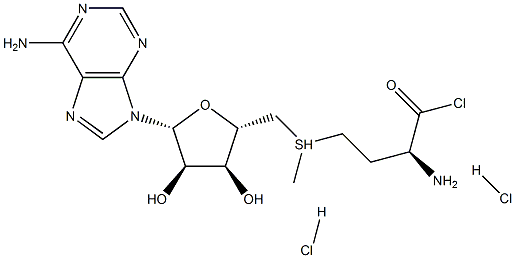
| Product Name: | S-(5'-Adenosyl)-L-Methionine chloride dihydrochloride | | Synonyms: | S-(5'-Adenosyl)-L-Methionine chloride dihydrochloride;SAM chloride dihydrochloride;5'-[[(3S)-3-Amino-3-carboxypropyl]methylsulfonio]-5'-deoxyadenosine chloride dihydrochloride;S-(5'-Adenosyl)-L-methionine chloride (hydrochloride);SAM; ADOMET;S-(5'-Adenosyl)-L-methionine chloride(SAM);-Adenosyl)-L-methionine chloride dihydrochloride;-Adenosyl)-L-methionine chloride (hydrochloride) | | CAS: | 86867-01-8 | | MF: | C15H25Cl3N6O4S | | MW: | 491.8208 | | EINECS: | 246-184-8 | | Product Categories: | | Mol File: | 86867-01-8.mol |
| S-(5'-Adenosyl)-L-Methionine chloride dihydrochloride Chemical Properties |
| storage temp. | -20°C | | solubility | H2O: soluble100mg/mL | | BRN | 6560002 |
| S-(5'-Adenosyl)-L-Methionine chloride dihydrochloride Usage And Synthesis |
| Description | S-(5''-Adenosyl)-L-methionine chloride (SAM) is a ubiquitous methyl donor involved in a wide variety of biological reactions, including those mediated by DNA and protein methyltransferases. The transfer of a methyl group from SAM to an acceptor produces S-adenosyl-L-homocysteine . SAM is also metabolized by SAM decarboxlase to give decarboxylated SAM, which is involved in the polyamine pathway that generates spermine. Cayman Chemical’s SAM has been purified to remove all S-adenosylhomocysteine, a known inhibitor of most SAM-dependent methyltransferases which is commonly found in other commercially available SAM. In addition, Cayman’s SAM contains no S-methylthioadenosine, a common impurity which may act as a substrate in some assay formats, resulting in high background. | | Uses | S-(5′-Adenosyl)-L-methionine chloride dihydrochloride has been used as a medium supplement for S30 cell extract. It also has been used for measuring the interaction with catechol-O-methyltransferase (COMT) by quartz crystal microbalance (QCM), surface plasmon resonance (SPR) and isothermal titration calorimetry (ITC) with supported lipid bilayers and vesicles. | | General Description | S-(5′-Adenosyl)-L-methionine chloride dihydrochloride (SAM) facilitates the transfer of methyl groups to proteins, lipids and nucleic acids. Methionine adenosyl transferase catalyses the synthesis of SAM from methionine and adenosine triphosphate (ATP). SAM functions to regulate various cellular functions like cell division, cell death, transcription, genetic stability, oxidant/antioxidant balance and polyamine homeostasis. Therapeutically, SAM finds its application as a nutritional supplement in humans for various diseases like osteoarthritis and liver injury. SAM also regulates transsulfuration reactions by binding to the regulatory domain of key enzyme cystathionine-β-synthase (CBS). | | Biochem/physiol Actions | Methyl donor; cofactor for enzyme-catalyzed methylations, including catechol O-methyltransferase (COMT) and DNA methyltransferases (DNMT). Although present in all cells, it is concentrated in liver where 85% of all methylation reactions occur. It is also involved in regulating liver function, growth, and response to injury. |
| S-(5'-Adenosyl)-L-Methionine chloride dihydrochloride Preparation Products And Raw materials |
|


 日本语
日本语 한국어
한국어 Français
 Deutsch
 España
 Türkiye