Other grades of this product :
| Disodium clodronate tetrahydrate Basic information |
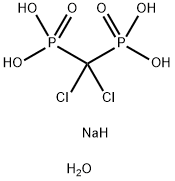
| Product Name: | Disodium clodronate tetrahydrate | | Synonyms: | DICHLOROMETHYLENE-BISPHOSPHONATE, DISODIUM TETRAHYDRATE;CLASTEON;CLASTOBAN;CLODRONIC ACID, DISODIUM SALT, TETRAHYDRATE;CLODRONATE DISODIUM SALT;CLODRONATE, DISODIUM SALT, TETRAHYDRATE;CLODRONATE, DISODIUM, TETRAHYDRATE;BONEFOS | | CAS: | 88416-50-6 | | MF: | CH7Cl2NaO7P2 | | MW: | 286.9 | | EINECS: | | Product Categories: | | Mol File: | 88416-50-6.mol |
| Disodium clodronate tetrahydrate Chemical Properties |
| storage temp. | 2-8°C | | solubility | Soluble in Water (up to at least 10 mg/ml) | | form | White solid | | color | White | | Merck | 14,2371 | | Stability: | Stable for 1 year from date of purchase as supplied. Solutions in distilled water may be stored at -20°C for up to 3 months. | | InChIKey | XWHPUCFOTRBMGS-UHFFFAOYSA-L |
| Disodium clodronate tetrahydrate Usage And Synthesis |
| Description | Bisphosphonates bind strongly to bone and reduce bone resorption through effects on both osteoclasts and osteoblasts. Clodronate is a non-nitrogenous bisphosphonate that has been used in the treatment of osteoporosis and other metabolic bone diseases. It binds to hydroxyapatite crystals with an affinity constant of 0.72 μM, inhibiting their growth (IC50 = 1.34 μM) and bone resorption. Clondronate is metabolized intracellularly to a β-γ-methylene analog of ATP that is cytotoxic to both osteoclasts and macrophages, which belong to the same cell lineage as osteoclasts. Liposome-encapsulated bisphosphonates such as clodronate have been used in biological research to selectively deplete macrophage-like cells and cancer cells. | | Uses | Disodium Clodronate Tetrahydrate is a bisphosphonate bone growth regulator. | | Definition | ChEBI: The tetrahydrate of the disodium salt of clodronic acid. It inhibits bone resorption and soft tissue calcification, and is used as an adjunct in the treatment of severe hypercalcaemia associated with malignancy, and in the management of osteolytic lesions
nd bone pain associated with skeletal metastases. | | References | 1) Plosker and Goa (1994), Clodronate. A review of its pharmacological properties and therapeutic efficacy in resorptive bone disease; Drugs 47 945
2) Lehenkari et al. (2002), Further Insight into Mechanism of Action of Clodronate: Inhibition of Mitochondrial ADP/ATP Translocase by a Nonhydrolyzable, Adenine-Containing Metabolite; Mol.Pharmacol. 61 1255 |
| Disodium clodronate tetrahydrate Preparation Products And Raw materials |
|


 日本语
日本语 한국어
한국어 Français
 Deutsch
 España
 Türkiye