Other grades of this product :
| TRYPSINOGEN Basic information |
| TRYPSINOGEN Chemical Properties |
| storage temp. | 2-8°C | | form | essentially salt-free, lyophilized powder |
| TRYPSINOGEN Usage And Synthesis |
| Uses | Trypsinogen from bovine pancreas is suitable for use in:- the secondary structure analysis of proteins in H2O solution using single-pass attenuated total reflection Fourier transform infrared (ATR-FT-IR) microscopy
- tuning and calibration of electrospray ionization quadrupole time-of-flight (ESI-Q-TOF) mass spectrometer
- the secondary structure analysis of proteins by infrared (IR) spectroscopy
- SDS-PAGE as a molecular weight standard (24kDa)
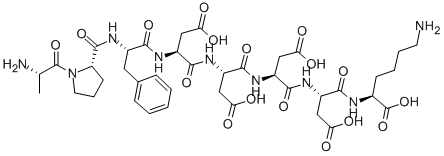
| | General Description | Trypsinogen is a proenzyme (zymogen) that is activated to form trypsin. It is synthesized in the pancreas and activated by enterokinase once it reaches the lumen of the small intestine. Bovine trypsinogen is a single polypeptide chain of 229 amino acids that is cross linked by six disulfide bridges. Enterokinase cleaves a hexapeptide to from the NH2 terminus of trypsinogen at the Lys6 - Ile7 peptide bond and activates it. Trypsin, thus formed, autocatalytically activates more trypsinogen to trypsin. This native form of trypsin is called β-trypsin, which undergoes autolysis at Lys131 - Ser132 resulting in α-trypsin that is held together by disulfide bridges. Trypsin is a serine protease with His46 and Ser183 at the active site. The pH optimum of trypsin is 7 - 9. | | Biochem/physiol Actions | Hereditary pancreatitis was shown to be caused by a Arg-His substitution at residue 117 of trypsinogen causing auto-activation of trypsinogen to trypsin. |
| TRYPSINOGEN Preparation Products And Raw materials |
|


 日本语
日本语 한국어
한국어 Français
 Deutsch
 España
 Türkiye