Other grades of this product :
| Metaldehyde Basic information |
| Metaldehyde Chemical Properties |
| Hazard Codes | Xn,T,F | | Risk Statements | 10-22-23-11 | | Safety Statements | 13-23-46-45 | | RIDADR | UN 1332 4.1/PG 3 | | WGK Germany | 1 | | RTECS | AB3042000 | | HazardClass | 4.1 | | PackingGroup | III | | HS Code | 29125000 | | Toxicity | Acute oral LD50 for dogs 0.6–1.0 g/kg (Worthing and Hance, 1991). |
| Metaldehyde Usage And Synthesis |
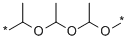
| Chemical Properties | White crystalline powder | | Uses | META(R) Metaldehyde is a highly effective active ingredient to control slugs and snails (molluscicide) WWW Link | | Uses | In compressed form as a fuel instead of alcohol; molluscicide. | | Uses | Molluscicide. | | Definition | A solid compound,C4O4H4(CH3)4, formed by polymerizationof ethanal (acetaldehyde) in diluteacid solutions below 0°C. Thecompound, a tetramer of ethanal, isused in slug pellets and as a fuel forportable stoves. | | Definition | A polymer of
acetaldehyde in which n usually is 4–6. | | Hazard | Flammable, dangerous fire risk. Strong irritant to skin and mucous membranes. | | Carcinogenicity | There is no evidence in the literature
that metaldehyde has carcinogenic potential. | | Environmental Fate | Plant. When applied to citrus rinds, 50% was lost after 4.6 days for the first 33 days
and an additional 25% was lost 14 days for the subsequent 26 days (Iwata et al., 1982).
Chemical/Physical. Metaldehyde can be converted to acetaldehyde by heating to 150°C
for 4–5 hours or by the reaction of concentrated hydrochloric acid (6 M) for a couple of
minutes (Booze and Oehme, 1985). |
| Metaldehyde Preparation Products And Raw materials |
|


 日本语
日本语 한국어
한국어 Français
 Deutsch
 España
 Türkiye