Other grades of this product :
| 2-PHENYLPROPIONALDEHYDE Chemical Properties |
| Melting point | 60°C | | Boiling point | 92-94 °C/12 mmHg (lit.) | | density | 1.002 g/mL at 25 °C (lit.) | | vapor pressure | 40Pa at 20℃ | | FEMA | 2886 | 2-PHENYLPROPIONALDEHYDE | | refractive index | n20/D 1.517(lit.) | | Fp | 169 °F | | storage temp. | 2-8°C | | solubility | Soluble in most fixed oils, propylene glycol. Insoluble in glycerin. | | form | Liquid | | color | Clear colorless | | Water Solubility | 10μg/L | | Sensitive | Air Sensitive | | JECFA Number | 1467 | | BRN | 4291321 | | InChIKey | IQVAERDLDAZARL-UHFFFAOYSA-N | | LogP | 1.96 | | CAS DataBase Reference | 93-53-8(CAS DataBase Reference) | | EPA Substance Registry System | Benzeneacetaldehyde, .alpha.-methyl- (93-53-8) |
| Hazard Codes | Xi | | Risk Statements | 36/37/38 | | Safety Statements | 26-36/37/39 | | WGK Germany | 3 | | RTECS | CY1460000 | | F | 9-23 | | TSCA | Yes | | HS Code | 29122990 |
| 2-PHENYLPROPIONALDEHYDE Usage And Synthesis |
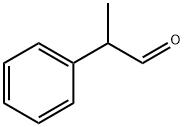
| Description | 2-phenylpropionaldehyde is also known as 2-phenylpropanal. It belongs to the family of phenylacetaldehydes. These are compounds containing a phenylacetaldehyde moiety, which consists of a phenyl group substituted at the second position by an acetalydehyde. 2- phenylpropionaldehyde is a naturally occurring compound in various foods including roasted nuts, cooked potatoes, cheese, wine, fruit, vegetables, coffee, tea, and cocoa. 2-phenylpropionaldehyde is used as a flavoring agent. Once absorbed, 2-phenylpropionaldehyde can be converted to phenyl-substituted carboxylic acids, which can be conjugated with glucuronic acid and excreted in the urine. 2-phenylpropionaldehyde can also undergo β- oxidation to benzoic acid or phenylacetic acid derivatives, which are conjugated with glycine or glutamine before being excreted in the urine.
| | References | [1] WHO Food Additives Series: 54, Safety evaluation of certain food additives
[2] https://webgate.ec.europa.eu
| | Chemical Properties | clear colorless liquid | | Chemical Properties | 2-PHENYLPROPIONALDEHYDE identified in dried
mushroom, is a colorless liquid with a green hyacinth odor. Hydratropaldehyde
can be hydrogenated to hydratropic alcohol, which is also used to a limited extent by reaction of p-ethylbenzyl chloride and isobutyric aldehyde in the presence of
catalysts. The product is used in perfumes for, for example, household products. | | Chemical Properties | 2-Phenylpropionaldehyde has an intense, green, floral odor reminiscent of hyacinth. | | Occurrence | Reported found in microbially fermented tea and some varieties of mushrooms. | | Uses | 2-Phenylpropionaldehyde is a precursor in the synthesis of N,N,β-Trimethyl-phenethylamine Hydrochloride (T796625). | | Preparation | By alkaline condensation of acetophenone and ethyl chloroacetate; also by distillation of methylphenyl ethylene glycol in
91% yields (under atmospheric pressure). | | Synthesis Reference(s) | Journal of the American Chemical Society, 97, p. 5608, 1975 DOI: 10.1021/ja00852a062Organic Syntheses, Coll. Vol. 3, p. 733, 1955Tetrahedron Letters, 15, p. 3059, 1974 | | General Description | 2-Phenylpropionaldehyde is used in perfumes for its green hyacinth odor. | | Flammability and Explosibility | Nonflammable | | Trade name | Floralozone (IFF), Florazon (Symrise). | | Safety Profile | : Moderately toxic by
ingestion. Combustible liquid. When heated
to decomposition it emits acrid smoke and
irritating fumes. See also ALDEHYDES. | | Purification Methods | It may contain up to 15% of acetophenone. Purify it via the bisulfite addition compound [Lodge & Heathcock J Am Chem Soc 109 3353 1987] and see Chapter 2 for preparation and decomposition of bisulfite adducts. [Beilstein 7 IV 695.] |
| 2-PHENYLPROPIONALDEHYDE Preparation Products And Raw materials |
|


 日本语
日本语 한국어
한국어 Français
 Deutsch
 España
 Türkiye