Other grades of this product :
| L-Carnosine Chemical Properties |
| Melting point | 253 °C (dec.) (lit.) | | alpha | 20.9 º (c=1.5, H2O) | | Boiling point | 367.84°C (rough estimate) | | density | 1.2673 (rough estimate) | | vapor pressure | 0Pa at 25℃ | | refractive index | 21 ° (C=2, H2O) | | storage temp. | -20°C | | solubility | DMSO (Very Slightly), Water (Slightly) | | pka | 2.62(at 25℃) | | form | crystalline | | color | White | | Water Solubility | almost transparency | | Merck | 14,1850 | | BRN | 87671 | | Stability: | Stable, but may be heat sensitive - store cold. Incompatible with strong oxidizing agents. | | InChIKey | CQOVPNPJLQNMDC-ZETCQYMHSA-N | | LogP | -3.8 at 22℃ | | CAS DataBase Reference | 305-84-0(CAS DataBase Reference) | | EPA Substance Registry System | L-Histidine, .beta.-alanyl- (305-84-0) |
| Hazard Codes | Xn | | Risk Statements | 20/21/22-36/37/38 | | Safety Statements | 24/25-36-26 | | WGK Germany | 2 | | RTECS | MS3080000 | | F | 3-10 | | TSCA | Yes | | HS Code | 29332900 | | Toxicity | LD50 oral in mouse: > 14930mg/kg |
| L-Carnosine Usage And Synthesis |
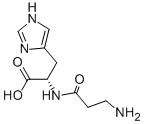
| Description | Carnosine is a dipeptide comprising beta-alanine and histidine. It is found in muscular and other tissues. It has strong oxidant property as it can scavenge both reactive oxygen species (ROS) and reactive nitrogen species (RNS). Carnosine acts as a cytosolic buffering agent and as a regulator of macrophage function.1 Attributing to its ability to form complexes with transition metals, it is used to regulate the content of transition metal ions in biological fluids and tissues.
Carnosine can prevent aging and can be used to prevent or treat complications of diabetes such as nerve damage, eye disorders (cataracts), and kidney problems.2 Potential therapeutic actions of carnosine include antihypertensive effects, immunomodulation, would healing, and antitumor/chemopreventive effects. The chelate compound of zinc ion and carnosine has been used in Japan for gastritis, gastric ulcers, and dyspepsia symptoms.3
| | Reference |
- P. J. Quinn, A. A. Boldyrev, V. E. Formazuyk, Carnosine: Its properties, functions and potential therapeutic applications, Molecular Aspects of Medicine, 1992, vol. 13, pp. 379-444
- https://www.webmd.com/vitamins/ai/ingredientmono-1038/carnosine
- G. M. Halpern, Zinc-Carnosine: Nature’s Safe and Effective Remedy for Ulcers, 2005, ISBN-10 0757002749
| | Description | L-Carnosine is a dipeptide composed of β-alanine and L-histidine that has been found in rat olfactory bulb, skeletal muscle, brain, kidney, and spleen tissues, as well as human skeletal muscle, and has diverse biological activities. It is a metal chelator that forms complexes with copper, cobalt, nickel, cadmium, or zinc. Dietary administration of L-carnosine (60 mg/kg per day) reduces plasma levels of advanced glycation end products (AGEs) in diabetic rats. It reduces brain edema, blood-brain barrier disruption, microglial activation, and neuronal apoptosis in a rat model of intracerebral hemorrhage when administered at a dose of 1,000 mg/kg. L-Carnosine (250, 500, and 1,000 mg/kg, i.p.) reduces hepatic protein carbonylation and necrosis in a rat model of cirrhosis induced by bile duct ligation. It also reduces lung myeloperoxidase (MPO) activity, production of reactive oxygen species (ROS), and TNF-α and IL-6 levels, as well as alveolar hemorrhage, interstitial edema, and pulmonary leukocyte infiltration in a mouse model of LPS-induced lung injury. | | Chemical Properties | Crystalline | | Uses | antioxidant, antisenescense, antineoplastic | | Uses | L-Carnosine is a naturally-occurring histidine-containing compound and the biological role of this dipeptide is to act as cytosolic buffering agents. Other roles ascribed to L-Carnosine include action
s as neurotransmitters, modulation of enzymic activities and chelation of heavy metals. | | Uses | carnosine is an anti-oxidant that works to prevent cellular damage because of free radical activity. Studies indicate an ability to boost the immunological functions. Carnosine is a naturally occurring amino acid. In cosmetics, it has anti-aging and skin-conditioning applications. | | Definition | ChEBI: A dipeptide that is the N-(beta-alanyl) derivative of L-histidine. | | benefits | L-Carnosine is a strong anti-glycosylation, free radical scavenging,anti-oxidant,anti-aging, anti-pollution.Brightenand repairthe skin. white powder.Its recommended dosage is 0.05~2%. | | Synthesis Reference(s) | The Journal of Organic Chemistry, 48, p. 392, 1983 DOI: 10.1021/jo00151a026 | | Flammability and Explosibility | Notclassified | | Biochem/physiol Actions | L-Carosine is a dipeptide found at millimolar concentration in brain, muscle and the lens of the eye. In model systems it is a potent antioxidant that scavenges oxygen free radicals and transition metal ions. It blocks protein-protein and protein-DNA cross-links induced by hypochlorite anions and toxic aldehydes such as acetaldehyde, formaldehyde, and malondialdehyde, the primary product of lipid peroxidation. It also inhibits nonenzymatic protein glycation induced by aldose and ketose reducing sugars and inhibits the formation of toxic advanced glycation end products (AGE). These activities make it of interest in studies of aging, atherosclerosis, Alzheimer′s disease, and the secondary effects of diabetes. | | Safety Profile | Mildly toxic by
intraperitoneal route. An experimental
teratogen. Other experimental reproductive
effects. When heated to decomposition it
emits toxic fumes of NOx. | | Purification Methods | Likely impurities are histidine and β-alanine. Crystallise L-carnosine from water by adding EtOH in excess. Recrystallise it from aqueous EtOH by slow addition of EtOH to a strong aqueous solution of the dipeptide. Its solubility in H2O is 33.3% at 25o. [Vinick & Jung J Org Chem 48 392 1983, Turner J Am Chem Soc 75 2388 1953, Sifford & du Vigneaud J Biol Chem 108 753 1935, Beilstein 25 H 516, 25 I 717, 25 II 408.] |
| L-Carnosine Preparation Products And Raw materials |
|


 日本语
日本语 한국어
한국어 Français
 Deutsch
 España
 Türkiye