Other grades of this product :
| Tranylcypromine Basic information |
| Tranylcypromine Chemical Properties |
| Melting point | 162-169 °C(lit.) | | storage temp. | 2-8°C | | solubility | Methanol (Slightly), Water (Slightly) | | form | Powder or Chunks | | color | White to light beige | | optical activity | [α]/D 1 to +1.0°, c = 1 in H2O | | Stability: | Hygroscopic |
| Tranylcypromine Usage And Synthesis |
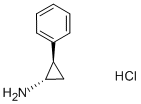
| Chemical Properties | white to light beige powder or chunks | | Uses | Antidepressant;MAO inhibitor | | Uses | As with the MAO inhibitor drugs described above, tranylcypromine is also used for
depressions that do not respond to other drugs. | | Uses | Non-selective MAO-A/B inhibitor | | General Description | A cell-permeable phenylcyclopropylamine that inhibits the monoamine oxidase and histone demethylase activities, respectively, of MAO A/B (Ki = 101.9 and 16.0 M, respectively) and LSD1/2 (Ki = 242.7 and 180.0 M, respectively), four members of a flavin-dependent amine oxidase family enzymes, by a covalent adduct formation with the enzyme-bound FAD. In addition to preventing LSD1-CoREST (Corepressor of RE1-Silencing Transcription factor) complex-mediated H3K4 demethylation (IC50<2 M), TCP also inhibits LSD1-HCF-1 (Host Cell Factor-1) complex-mediated H3K9 demethylase activity, which is demonstrated to be an essential mechanism for the replication and latent infection of the α-herpesviruses HSV and VZV. The combined treatment of 2 M TCP and 10 M CHIR99061 is reported to enable the reprogramming of Oct4/Klf4-transduced primary HNEKs (Human Neonatal Epidermal Keratinocytes) into iPS (induced Pluripotent Stem) cells, albeit at a 100-time lower efficiency as seen in cultures transduced with 4-TFs (Oct44, Klf4, Sox2, and c-Myc). | | Biological Activity | Irreversible inhibitor of lysine-specific demethylase 1 (LSD1/BHC110) and monoamine oxidase (MAO) (K i values are 242, 102 and 16 μ M for LSD1, MAO-A and MAO-B respectively). Inhibits histone demethylation. | | Clinical Use | MAOI antidepressant | | Synthesis | Tranylcypromine, (±)-trans-2-phenylcyclopropylamine (7.2.10),
differs from the drugs described above in that it is not a derivative of hydrazine. It is
synthesized from the ethyl ester of 2-phenylcyclopropan carboxylic acid (7.2.7), which is synthesized by the reaction of styrene with ethyl diazoacetate. 2-phenylcyclopropancarboxylic acid ethyl ester (7.2.7) is hydrolyzed by alkali to 2-phenylcyclopropancarboxylic acid (7.2.8) and the trans-isomer is separated for further reactions. The reaction
of the trans-isomer with thionyl chloride gives trans-2-phenylcyclopropancarboxylic
acid chloride (7.2.9), which upon reaction with sodium azide gives the respective acid
azide, which undergoes Curtius rearrangement to the transcyclopropylamine (7.2.10)
[48,49]. | | Drug interactions | Potentially hazardous interactions with other drugs
Alcohol: some alcoholic and dealcoholised drinks
contain tyramine which can cause hypertensive crisis.
Alpha-blockers: enhanced hypotensive effect; avoid
with indoramin.
Analgesics: CNS excitation or depression with
pethidine, other opioids and nefopam - avoid;
increased risk of serotonergic effects and convulsions
with tramadol - avoid.
Antibacterials: increased risk of hypertension and
CNS excitation with linezolid and tedizolid - avoid
for at least 2 weeks after stopping MAOIs.
Antidepressants: enhancement of CNS effects and
toxicity. Care with all antidepressants including drug
free periods when changing therapies.
Antidiabetics: possibly enhanced hypoglycaemic
effect.
Antiepileptics: antagonism of anticonvulsant effect;
avoid carbamazepine with or within 2 weeks of
MAOIs.
Antihypertensives: enhanced hypotensive effect.
Antimalarials: avoid with artemether/lumefantrine
and piperaquine with artenimol.
Antipsychotics: effects enhanced by clozapine.
Anxiolytics: avoid buspirone with or within 2 weeks
of MAOIs.
Atomoxetine: avoid concomitant use and for 2 weeks
after use; increased risk of convulsions.
Bupropion: avoid with or for 2 weeks after MAOIs.
Dapoxetine: risk of hypertensive crisis - avoid.
Diuretics: enhanced hypotensive effect; avoid with
indoramin.
Dopaminergics: avoid with entacapone, safinamide
and tolcapone; hypertensive crisis with levodopa and
rasagiline - avoid for at least 2 weeks after stopping
MAOI; hypotension with selegiline.
5HT1
agonist: risk of CNS toxicity with
sumatriptan, rizatriptan and zolmitriptan - avoid
sumatriptan and rizatriptan for 2 weeks after MAOI.
Metaraminol: risk of hypertensive crisis - avoid for
at least 2 weeks after stopping MAOIs.
Methyldopa: avoid concomitant use.
Opicapone: avoid concomitant use.
Sympathomimetics: hypertensive crisis with
sympathomimetics - avoid.
Tetrabenazine: risk of CNS excitation and
hypertension avoid. | | Metabolism | Tranylcypromine undergoes considerable hepatic metabolism, including breakdown of the side chain and probably conjugation. Excretion is renal mainly as metabolites. |
| Tranylcypromine Preparation Products And Raw materials |
|


 日本语
日本语 한국어
한국어 Français
 Deutsch
 España
 Türkiye