Other grades of this product :
| Biphenyl-3-boronic acid Basic information | | Uses |
| Biphenyl-3-boronic acid Chemical Properties |
| Melting point | 193-198 °C (lit.) | | Boiling point | 411.0±38.0 °C(Predicted) | | density | 1.18±0.1 g/cm3(Predicted) | | storage temp. | Keep in dark place,Sealed in dry,Room Temperature | | solubility | DMSO (Slightly), Methanol (Slightly) | | form | solid | | pka | 8.30±0.10(Predicted) | | color | White to Off-White | | Water Solubility | Insoluble in water. | | BRN | 2836311 | | InChIKey | GOXICVKOZJFRMB-UHFFFAOYSA-N | | CAS DataBase Reference | 5122-95-2(CAS DataBase Reference) |
| Hazard Codes | Xi,C | | Risk Statements | 36/37/38 | | Safety Statements | 37/39-26 | | WGK Germany | 3 | | Hazard Note | Corrosive | | HS Code | 29163990 |
| Biphenyl-3-boronic acid Usage And Synthesis |
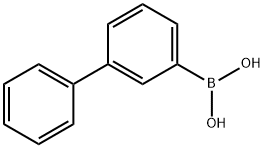
| Uses | 3-Biphenylboronic Acid is a fluorescent boronic acid useful for sensitive detection of sugars in water. | | Chemical Properties | yellow crystal powder | | Uses | suzuki reaction | | Uses | It is a biological reagent used as a boronate-assisted fluorogenic chemosensor. It is evaluated for pharmacological activity as fatty acid amide hydrolase inhibitors. It is a reactant involved in coupling with potassium cyanate, quinones, or fluorous tagged N-hydroxyphthalimide and direct C-H arylation of electron-deficient heterocycles. | | Uses | Biological reagent used as a boronate-assisted fluorogenic chemosensorEvaluated for pharmacological activity as fatty acid amide hydrolase inhibitorsReactant involved in:- Coupling with potassium cyanate, quinones, or fluorous tagged N-hydroxyphthalimide
- Direct C-H arylation of electron-deficient heterocycles
|
| Biphenyl-3-boronic acid Preparation Products And Raw materials |
|


 日本语
日本语 한국어
한국어 Français
 Deutsch
 España
 Türkiye