Other grades of this product :
| 2-Ethylhexyl acrylate Basic information |
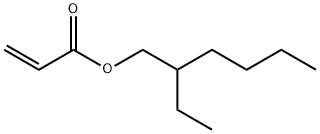
| Product Name: | 2-Ethylhexyl acrylate | | Synonyms: | 2-ETHYLHEXYL ACRYLATE extrapure;2-Ethylhexyl acrylate ,99% [contains 10-20 ppm MEHQ as inhibitor];2-ETHYLHEXYL ACRYLATE, 99+%, STABILIZED;2-Ethylhexyl acrylate, stabilized;Acrylic acid 2-ethylhexyl;Propenoic acid 2-ethylhexyl ester;2-Ethylhexyl acrylate, stabilized, 99+% 1KG;Acrylic Acid 2-Ethylhexyl Ester Monomer
Acrylic Acid Octyl Ester Monomer
Octyl Acrylate Monomer | | CAS: | 103-11-7 | | MF: | C11H20O2 | | MW: | 184.28 | | EINECS: | 203-080-7 | | Product Categories: | Industrial/Fine Chemicals;ester series | | Mol File: | 103-11-7.mol |
| 2-Ethylhexyl acrylate Chemical Properties |
| Melting point | -90°C | | Boiling point | 215-219 °C(lit.) | | density | 0.885 g/mL at 25 °C(lit.) | | vapor density | 6.4 (vs air) | | vapor pressure | 0.15 mm Hg ( 20 °C) | | refractive index | n20/D 1.436(lit.) | | Fp | 175 °F | | storage temp. | Store below +30°C. | | solubility | 0.1g/l | | form | Liquid | | color | Clear | | Odor | Ester like odour | | explosive limit | 0.9-6.0%(V) | | Water Solubility | <0.1 g/100 mL at 22 ºC | | BRN | 1765828 | | Exposure limits | ACGIH: TWA 5 mg/m3NIOSH: TWA 5 mg/m3 | | Stability: | Stability Stable, but polymerizes readily, so is usually inhibited with hydroquinone or its monomethyl ether. Susceptible to hydrolysis. Combustible. Incompatible with oxidizing agents. | | InChIKey | GOXQRTZXKQZDDN-UHFFFAOYSA-N | | LogP | 4 at 20℃ | | CAS DataBase Reference | 103-11-7(CAS DataBase Reference) | | NIST Chemistry Reference | 2-Propenoic acid, 2-ethylhexyl ester(103-11-7) | | IARC | 2B (Vol. 60, 122) 2019 | | EPA Substance Registry System | 2-Ethylhexyl acrylate (103-11-7) |
| Hazard Codes | Xi | | Risk Statements | 37/38-43 | | Safety Statements | 36/37-46 | | RIDADR | UN 3334 | | WGK Germany | 1 | | RTECS | AT0855000 | | F | 10-23 | | Autoignition Temperature | 496 °F | | TSCA | Yes | | HS Code | 29161290 | | Hazardous Substances Data | 103-11-7(Hazardous Substances Data) | | Toxicity | LD50 orally in Rabbit: 4435 mg/kg LD50 dermal Rabbit 7522 mg/kg |
| 2-Ethylhexyl acrylate Usage And Synthesis |
| Description | 2-Ethylliexyl aerylate was contained in a surgieal tape
and caused allergic contact dermatitis in a patient. | | Chemical Properties | light yellow liquid | | Chemical Properties | 2-Ethylhexyl acrylate is a combustible, colorless
liquid with a pleasant odor | | Uses | Monomer for plastics, protective coatings,
paper treatment, water-based paints. | | Uses | As a plasticizing co-monomer for the
production of resins used in adhesives, latex,
paints, textile and leather finishes, and coatings
for paper | | Uses | 2-ethylhexyl acrylate is a monomer for plastics, protective coating, paper treatment, water-based paints, UV-curable coatings, and inks; in so me acrylicbased adhesive tapes. | | General Description | A clear colorless liquid with a pleasant odor. Less dense than water and insoluble in water. Vapors heavier than air. Flash point 180°F. Used in making of paints and plastics. | | Air & Water Reactions | Insoluble in water. | | Reactivity Profile | 2-Ethylhexyl acrylate polymerizes readily in the presence of heat and light generating much heat; reacts with strong oxidants. REF [Handling Chemicals Safely, 1980. p. 235]. | | Hazard | Questionable carcinogen. | | Health Hazard | Inhalation of concentrated vapor causes drowsiness and convulsions. Liquid causes irritation of eyes and may irritate skin on prolonged exposure. Ingestion produces same symptoms as inhalation. | | Fire Hazard | Behavior in Fire: Heat can result in a severe polymerization with rapid release of energy. Sealed containers may rupture explosively if hot. | | Flammability and Explosibility | Notclassified | | Potential Exposure | A potential danger to those involved
in the use of this monomer as a feedstock for chemical syntheses; in the manufacture of plastics; protective coatings,
including water-based paints; in paper treatment; the production of emulsion polymers. | | Incompatibilities | Unless inhibited, sunlight, heat, contaminants, or peroxides can cause dangerous polymerization.
Vapors are uninhibited and may polymerize, blocking
vents. Violent reaction with strong oxidizers, with risk of
fire and explosions. May form explosive mixture with air.
Incompatible with strong acids; aliphatic amines;
alkanolamines. | | Waste Disposal | Spray into incinerator with
added flammable solvent. |
| 2-Ethylhexyl acrylate Preparation Products And Raw materials |
|


 日本语
日本语 한국어
한국어 Français
 Deutsch
 España
 Türkiye