Other grades of this product :
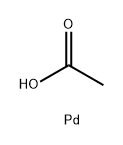
| Palladium (II) Acetate Basic information | | Reactions |
| Palladium (II) Acetate Chemical Properties |
| Melting point | 205 °C | | vapor pressure | 0.002Pa at 25℃ | | storage temp. | Store below +30°C. | | solubility | Soluble as monomer in glacial acetic acid or as trimer in benzene. | | form | Various Forms In Red-(Powder/Flake/Crystalline/Beads) | | color | Red-brown | | PH | 2-3 (H2O, 20℃)(aqueous suspension) | | PH Range | 2.0 - 3.0 at 20 °C | | Water Solubility | insoluble | | Sensitive | Hygroscopic | | λmax | 400nm(EtOH)(lit.) | | Hydrolytic Sensitivity | 4: no reaction with water under neutral conditions | | Merck | 14,6991 | | BRN | 6086766 | | InChIKey | PCUVQHHZCJMCHO-UHFFFAOYSA-M | | LogP | -0.17 at 20℃ | | CAS DataBase Reference | 3375-31-3(CAS DataBase Reference) | | EPA Substance Registry System | Acetic acid, palladium(2+) salt (3375-31-3) |
| Palladium (II) Acetate Usage And Synthesis |
| Reactions |
- Efficient catalyst for the arylation of olefins (Heck reaction).
- Catalyst for cross-coupling reactions.
- Catalyst for C-H activation.
- Precatalyst for enantioselective decarboxylative protonation of allyl β-ketoesters.
| | Chemical Properties | brown needles | | Uses | suzuki reaction | | Uses | Palladium (II) Acetate Trimer is used in Suzuki-Miyaura cross-coupling reactions. It also serves to catalyze the chemoselective reduction of nitroarenes. | | Uses | A catalyst for intramolecular coupling. | | General Description | Palladium(II) acetate is a homogenous oxidation catalyst. It participates in the activation of alkenic and aromatic compounds towards oxidative inter- and intramolecular nucleophilic reactions. Crystals of palladium(II) acetate have a trimeric structure, having symmetry D3h. Each of the palladium atoms in the crystals are joined to the other two by double acetate bridges. Microencapsulation of palladium(II) acetate in polyurea affords polyurea-encapsulated palladium(II) acetate. It is a versatile heterogeneous catalyst for various phosphine-free cross-coupling reactions. It participates as catalyst in the Heck coupling reaction of pthalides with different alkenes. | | Flammability and Explosibility | Nonflammable | | Safety Profile | Moderately toxic by ingestion. When heated to decomposition it emits toxic vapors of palladium. | | Purification Methods | It recrystallises from CHCl3 as purple crystals. It can be washed with AcOH and H2O and dried in air. Large crystals are obtained by dissolving it in *C6H6, adding half its volume of AcOH and allowing it to evaporate slowly at room temperature. It forms green adducts with nitrogen donors, it dissolves in KI solution to form solid PdI2 and a red solution of PdI42-, but is insoluble in aqueous saturated NaCl, and NaOAc. It dissolves in HCl to form PdCl42-. It is soluble in CHCl3, CH2Cl2, Me2CO, MeCN, Et2O, but it is insoluble in H2O, and decomposes when warmed in alcohols in which it is also insoluble. [Morehouse et al. Chem Ind (London) 544 1964, Stephenson et al. J Chem Soc 3632 1965, Skapski & Smart J Chem Soc (D) 658 1970, Heck Acc Chem Res 12 146 1979.] |
| Palladium (II) Acetate Preparation Products And Raw materials |
| Raw materials | Acetic acid-->Hydrazine hydrate-->Palladium chloride-->Sodium formate | | Preparation Products | (S)-(-)-7,7'-BIS[DI(3,5-DIMETHYLPHENYL)PHOSPHINO]-2,2',3,3'-TETRAHYDRO-1,1'-SPIROBIINDANE-->(R)-7,7'-BIS(DIPHENYLPHOSPHINO)-1,1'-SPIROBIINDANE-->Bergapten-->(R)-(+)-7,7'-BIS(DIPHENYLPHOSPHINO)-2,2',3,3'-TETRAHYDRO-1,1'-SPIROBIINDANE-->(R)-(+)-7,7'-BIS[DI(4-METHYLPHENYL)PHOSPHINO]-2,2',3,3'-TETRAHYDRO-1,1'-SPIROBIINDANE-->(S)-7,7'-Bis[di(p-methylphenyl)phosphino]-1,1'-spirobiindane ,97%-->4-(2-KETO-1-BENZIMIDAZOLINYL)PIPERIDINE-->Diphenylacetylene-->C-(3,4-DIHYDRO-2H-BENZO[1,4]OXAZIN-3-YL)-METHYLAMINE-->Ethyl (R)-2-hydroxy-4-phenylbutyrate-->3-AMINOBIPHENYL-->2,3-DIHYDRO-1H-INDOLE-5-CARBOXYLIC ACID-->5-CYANO-2,3-DIHYDRO-1H-INDOLE-->INDOLINE-6-CARBOXYLIC ACID-->ethyl indoline-6-carboxylate-->3-PHENYLBENZYLAMINE-->1-(4-Pyridyl)piperazine-->4,6-Diamino-2-pyrimidinol-->2-MORPHOLINO-5-(TRIFLUOROMETHYL)BENZALDEHYDE-->ethyl 1H-indole-6-carboxylate-->4-Aminobiphenyl-->N,N'-Bis- (1-naphthalenyl)-N,N'-bis-phenyl-(1,1'-biphenyl)-4,4'-diamine-->1-ACETYL-5-AMINO-2,3-DIHYDRO-(1H)-INDOLE-->5-Phenylthiophene-2-carboxylic acid-->5-PHENYL-2-THIOPHENECARBALDEHYDE-->(E)-METHYL 3-(4-BROMOPHENYL)ACRYLATE-->4-Aminophenylboronic acid pinacol ester-->5-Methylindole-->3-Phenyl-1H-pyrazole-->Allyl acetate |
|


 日本语
日本语 한국어
한국어 Français
 Deutsch
 España
 Türkiye