Other grades of this product :
| 4-Hydroxybenzoic acid Basic information |
| 4-Hydroxybenzoic acid Chemical Properties |
| Melting point | 213-217 °C (lit.) | | Boiling point | 213.5°C (rough estimate) | | density | 1,46 g/cm3 | | vapor pressure | 0Pa at 20℃ | | refractive index | 1.4600 (estimate) | | FEMA | 3986 | 4-HYDROXYBENZOIC ACID | | Fp | 199 °C | | storage temp. | Store below +30°C. | | solubility | methanol: soluble5%, clear to slightly hazy, colorless to faintly yellow | | form | Crystalline Powder | | pka | 4.48(at 19℃) | | color | White to ivory | | PH | 3.3 (1g/l, H2O, 20℃) | | Water Solubility | 5 g/L (20 ºC) | | Merck | 14,4812 | | JECFA Number | 957 | | BRN | 970950 | | InChIKey | FJKROLUGYXJWQN-UHFFFAOYSA-N | | LogP | 0.878 at 22℃ | | CAS DataBase Reference | 99-96-7(CAS DataBase Reference) | | NIST Chemistry Reference | Benzoic acid, 4-hydroxy-(99-96-7) | | EPA Substance Registry System | p-Hydroxybenzoic acid (99-96-7) |
| 4-Hydroxybenzoic acid Usage And Synthesis |
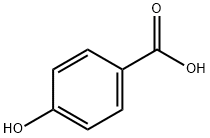
| Description | 4-Hydroxybenzoic acid, also known as p-hydroxybenzoic acid (PHBA), is a monohydroxybenzoic acid, a phenolic derivative of benzoic acid. It is a white crystalline solid that is slightly soluble in water and chloroform but more soluble in polar organic solvents such as alcohols and acetone. 4-Hydroxybenzoic acid is primarily known as the basis for the preparation of its esters, known as parabens, which are used as preservatives in cosmetics and some ophthalmic solutions. It is isomeric with 2-hydroxybenzoic acid, known as salicylic acid, a precursor to aspirin, and with 3-hydroxybenzoic acid.4-Hydroxybenzoic acid belongs to the class of aromatic acids, which may be used as a preservative in cosmetics, pharmaceuticals and as a synthetic flavoring agent in food products. | | Description | 4-Hydroxybenzoic acid is a phenolic acid that has been found in a variety of fruit peels and leaves. | | Chemical Properties | 4-Hydroxybenzoic acid is an odorless white crystalline astringent powder. In pure form, it imparts a sweetish taste at
first, which quickly becomes acrid and disagreeable | | Occurrence | Reportedly present in apple juice, black currant, cheese, beer, grape brandy, rum, sherry, wines, cocoa, peanut,
soybean and wort. | | Occurrence | 4-Hydroxybenzoic acid is a phenolic acid that has been found in a variety of fruit peels and leaves. It can be found naturally in coconut. It is one of the main catechins metabolites found in humans after consumption of green tea infusions. It is also found in wine, in vanilla, in Macrotyloma uniflorum (horse gram), carob and in Phyllanthus acidus (Otaheite gooseberry). | | Uses | 4-Hydroxybenzoic acid is used as an intermediate for dyes, antiseptics and active pharmaceutical ingredients. It is also used as a food preservative, corrosion inhibitor, anti-oxidant and an emulsifier. It reacts with 6-hydroxynaphthalene-2-carboxylic acid to prepare aromatic polyester called Vectran fiber. It acts as a precursor to prepare p-hydroxyphenylbenzoate, p-acetoxybenzoyl chloride and 4,4'-dihydroxybenzophenone. Further, it is used in paint additives, coating additives, processing aids, electrical and electronic products. In addition to this, it acts as a preservative in cosmetics and some ophthalmic solutions. | | Uses | p-Hydroxybenzoic acid is of significant commercial importance. The most familiar application is the use of several of its esters as preservatives, known as parabens. Also of interest is the use in liquid crystal polymer applications. | | Uses | Acetylsalicylic Acid Impurity A | | Uses | In organic. syntheses; intermediate for dyes, fungicides. | | Definition | ChEBI: A monohydroxybenzoic acid that is benzoic acid carrying a hydroxy substituent at C-4 of the benzene ring. | | Application | 4-Hydroxybenzoic acid can be used as a starting material to synthesize organic intermediates such as 4-acetoxybenzoic acid and 4-hydroxy-3,5-diiodobenzoic acid.4-Hydroxybenzoic acid is used as an intermediate for dyes, antiseptics and active pharmaceutical ingredients. It is also used as a food preservative, corrosion inhibitor, anti-oxidant and an emulsifier. It reacts with 6-hydroxynaphthalene-2-carboxylic acid to prepare aromatic polyester called Vectran fiber. It acts as a precursor to prepare p-hydroxyphenylbenzoate, p-acetoxybenzoyl chloride and 4,4′-dihydroxybenzophenone. Further, it is used in paint additives, coating additives, processing aids, electrical and electronic products. In addition to this, it acts as a preservative in cosmetics and some ophthalmic solutions. | | Preparation | Prepared from p-bromophenol or p-hydroxybenzaldehyde, or from saponification of methyl salicylate, a major component
of oil of wintergreen.In 1947, H. Gilman and C. E. Arntzen at Iowa State College (Ames) reported the synthesis of 4-HBA from 4-hydroxybenzaldehyde. Several other preparation methods were developed since then. Today it is produced commercially via the Kolbe–Schmitt reaction, which originated in the mid-1800s. Potassium phenoxide and CO2 are heated under pressure; the reaction mixture is then acidified to obtain the product. (Oddly, if the sodium salt is used, the product is 2-hydroxybenzoic acid, or salicylic acid.)Org. Synth. 1934, 14, 48DOI: 10.15227/orgsyn.014.0048 | | Aroma threshold values | Detection at 5 ppm (water) | | Synthesis Reference(s) | Journal of the American Chemical Society, 106, p. 174, 1984 DOI: 10.1021/ja00313a035The Journal of Organic Chemistry, 29, p. 3459, 1964 DOI: 10.1021/jo01035a003 | | General Description | Pharmaceutical secondary standards for application in quality control provide pharma laboratories and manufacturers with a convenient and cost-effective alternative to the preparation of in-house working standards. 4-Hydroxybenzoic acid belongs to the class of aromatic acids, which may be used as a preservative in cosmetics, pharmaceuticals and as a synthetic flavoring agent in food products. | | Flammability and Explosibility | Nonflammable | | Purification Methods | Crystallise the hydroxyacid from water. [Beilstein 10 IV 345.] |
| 4-Hydroxybenzoic acid Preparation Products And Raw materials |
|


 日本语
日本语 한국어
한국어 Français
 Deutsch
 España
 Türkiye