Other grades of this product :
| Octreotide acetate Basic information |
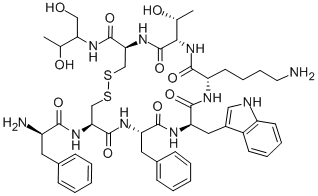
| Product Name: | Octreotide acetate | | Synonyms: | DARAMONOL;ctreotide;Ocetreotide, Acetate;L-Cysteinamide, D-phenylalanyl-L-cysteinyl-L-phenylalanyl-D-tryptophyl-L-lysyl-L-threonyl-N-(1R,2R)-2-hydroxy-1-(hydroxymethyl)propyl-, cyclic (2?7)-disulfide;OXTREOTIDE;[R-(R*,R*)]-D-Phenylalanyl-L-cysteinyl-L-phenylalanyl-D-tryptophyl-L-lysyl-L-threonyl-N-[2-hydroxy-1-(hydroxy-methyl)propyl]-cysteinamide cyclic(2->7)-disulfide;Octreotide acetate;L-cysteinamide, D-phenylalanyl-L-cysteinyl-L-phenylalanyl-D-tryptophyl-L-lysyl-L-threonyl-N-(2-hydroxy-1-(hydroxymethyl) propyl)-cyclic (2->7)-disulfide, (R-(R*,R*)) | | CAS: | 83150-76-9 | | MF: | C49H66N10O10S2 | | MW: | 1019.24 | | EINECS: | 1533716-785-6 | | Product Categories: | Inhibitors;API;Peptide | | Mol File: | 83150-76-9.mol |
| Octreotide acetate Chemical Properties |
| Melting point | >140°C (dec.) | | Boiling point | 1447.2±65.0 °C(Predicted) | | density | 1.39±0.1 g/cm3(Predicted) | | storage temp. | -20°C | | solubility | Soluble in acetic acid, DMSO, and methanol | | pka | 12.60±0.70(Predicted) | | form | Solid | | color | White to Off-White | | Stability: | Hygroscopic | | InChIKey | DEQANNDTNATYII-MEUDYGGUSA-N | | CAS DataBase Reference | 83150-76-9 |
| Octreotide acetate Usage And Synthesis |
| Description | Octreotide is a long-acting somatostatin analog indicated for symptomatic control in
acromegaly and gastroenteropancreatic tumors. Other potential uses under investigation
include diabetes, psoriasis and Alzheimer's disease. | | Originator | Sandoz (Switzerland) | | Uses | Octreotide Acetate is the acetate salt of a synthetic long-acting cyclic octapeptide with pharmacologic properties mimicking those of the natural hormone somatostatin. It inhibits the secretion of growth hormone, glucagon, insulin, gastrin, vasoactive intestinal peptide, secretin, motilin and pancreatic polypeptide. Octreotide acetate was uses for the treatment of severe diarrhea and flushing associated with malignant carcinoid tumors, acromegaly, and diarrhea associated with VIPoma; and, then in 2010, for the treatment of neuroendocrine tumors. | | Indications | Octreotide acetate (Sandostatin) is a synthetic peptide
analogue of the hormone somatostatin. Its actions include
inhibition of the pituitary secretion of growth
hormone and an inhibition of pancreatic islet cell secretion
of insulin and glucagon. Unlike somatostatin, which
has a plasma half-life of a few minutes, octreotide has a
plasma elimination half-life of 1 to 2 hours. Excretion of
the drug is primarily renal. | | Brand name | Sandostatin (Novartis). | | Therapeutic Function | Antiulcer, Growth hormone inhibitor | | Biological Functions | Octreotide acetate, a long-acting octapeptide analogue of somatostatin, has a half-life of
approximately 100 minutes. A comparison of the primary structures of octreotide and
somatostatin suggests little similarity, but from earlier work at the Salk Institute it was known
that not all the residues in somatostatin were necessary to elicit its full biological activity. Other
studies suggested that the essential fragment for its activity was the tetrapeptide Phe7-Trp8-
Lys9-Thr10. These earlier studies helped in the design of the potent drug now known as octreotide acetate. This drug suppresses the secretion of gastroenteropancreatic
peptides, such as gastrin, vasoactive intestinal peptide (VIP), insulin, and glucagon, as well as
pituitary GH. Furthermore, it is more potent than natural somatostatin in inhibiting the release of
glucagon, insulin, and GH. | | General Description | Octreotide is a somatostatin analogue with D-Phe-Cys-Phe-D-Trp-Lys-ThrCys-Thr-OH amino acid sequence. | | Biochem/physiol Actions | Octreotide is three times more potent than the native hormone in inhibiting the secretion of growth hormone glucagon and insulin in vivo. Octreotide regulates serum prolactin levels and resolves galactorrhea or (secondary) amenorrhea in acromegaly patients. Hence, this peptide can be considered as a potent therapeutic for acromegaly treatment. | | Clinical Use | Octreotide acetate is used by SC injection in the palliative treatment of patients with metastatic
carcinoid tumors, which are tumors of the endocrine system, GI tract, and lung
(gastroenteropancreatic). Carcinoid tumors secrete increasing amounts of vasoactive
substances, including histamine, serotonin, bradykinin, and prostaglandins. Octreotide acetate
inhibits or suppresses the release of these vasoactive substances and, thus, is useful in treating
the severe diarrhea, facial flushing, and wheezing episodes that accompany carcinoid tumors. In
addition, it finds use in the palliative management of VIP-secreting tumors (VIPomas, usually
pancreatic tumors). Patients with VIPomas suffer a profuse, watery diarrhea syndrome, and
octreotide acetate is able to help by decreasing the release of damaging intestinal tumor cell
secretions. Octreotide also helps to reduce hypokalemia by correcting electrolyte imbalances.An excessive secretion of GH from the pituitary can cause the disorder known as acromegaly,
which is characterized by a progressive enlargement of the head, face, hands, feet, and thorax.
Inasmuch as octreotide acetate is able to decrease the secretion of GH from the pituitary, it is
used in treating patients with acromegaly who are unresponsive to previous pituitary radiation
therapy or surgery. It is used in the treatment of acromegaly, because it reduces the blood
levels of both GH and insulin-like growth factor-I (IGF-I). The long-acting repository form of
octreotide acetate also is used in treating acromegaly, carcinoid tumors, and VIPomas, but in
monthly depot injections.Octreotide for IV injection is used in the treatment of acute bleeding from esophageal varices.
Variceal bleeding occurs in about half the patients with cirrhosis of the liver and is responsible
for about one-third of deaths in these patients. Octreotide is a potent vasoconstrictor that
reduces portal and collateral blood flow by constricting visceral vessels, which leads to reduced
portal blood pressure and decreases the bleeding. | | Veterinary Drugs and Treatments | Octreotide may be useful in the adjunctive treatment of hyperinsulinemia
in patients with insulinomas (especially dogs, ferrets).
Response is variable, presumably dependent on whether the tumor
cells have receptors for somatostatin. Octreotide may also be useful
in the diagnosis and symptomatic treatment of gastrinomas in dogs
or cats. It may be of use in the treatment of acute pancreatitis, but
more research is needed before it can be recommended for this use
in veterinary patients. | | Mode of action | Octreotide acetate is a synthetic somatostatin analogue with similar pharmacologic effects to naturally occurring somatostatin, but with a prolonged duration of action. It inhibits pathologically increased secretion of growth hormone, thyroid stimulating hormone, and serotonin, insulin, glucagon, and other peptides produced within the gastro-entero-pancreatic endocrine system. Somatostatin is cell cycle phase-specific, mediating arrest at the G1- phase. Long acting somatostatin analogues have been shown to inhibit tumour growth. |
| Octreotide acetate Preparation Products And Raw materials |
|


 日本语
日本语 한국어
한국어 Français
 Deutsch
 España
 Türkiye