Other grades of this product :
| Monobenzone Basic information |
| Monobenzone Chemical Properties |
| Melting point | 119-120 °C (lit.) | | Boiling point | 297.96°C (rough estimate) | | density | 1,26 g/cm3 | | refractive index | 1.5906 (estimate) | | storage temp. | Store below +30°C. | | solubility | Chloroform (Slightly), DMSO (Slightly), Methanol (Slightly) | | pka | 10.29±0.15(Predicted) | | form | Powder, Crystals, and/or Chunks | | color | Off-white to beige to brown | | Water Solubility | slightly soluble | | Merck | 14,6248 | | BRN | 1958305 | | InChIKey | VYQNWZOUAUKGHI-UHFFFAOYSA-N | | CAS DataBase Reference | 103-16-2(CAS DataBase Reference) | | NIST Chemistry Reference | Monobenzone(103-16-2) | | EPA Substance Registry System | Monobenzone (103-16-2) |
| Monobenzone Usage And Synthesis |
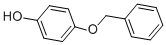
| Description | 4-(Benzyloxy)phenol, also called monobenzone and monobenzyl ether of hydroquinone (MBEH) is an organic chemical in the phenol family with chemical formula C6H5CH2OC6H4OH. It is used as a topical drug for medical depigmentation. Monobenzone occurs as a white, almost tasteless crystalline powder, soluble in alcohol and practically insoluble in water.The topical application of monobenzone in animals, increases the excretion of melanin from the melanocytes. The same action is thought to be responsible for the depigmenting effect of the drug in humans. | | Chemical Properties | 4-Benzyloxyphenol is a cream to beige-light brownish crystals classified as a hydroquinone monobenzyl ether. It is soluble in alcohol, benzene and ether, and almost insoluble in water. 4-Benzyloxyphenol is a depigmenting agent that has the effect of enhancing the rate of elimination of melanin secreted by skin cells, and studies have shown that the molecular mechanism of its action may be related to tyrosinase. | | Uses | PBP is used as antiinflammatory, antisecretory, antiulcer.
| | Uses | Hydroquinone monobenzyl ether is an antidegradant added to rubber products; inhibitor in acrylic resins. | | Uses | 4-Benzyloxyphenol is used in the synthesis of bis(4-benzyloxyphenoxy)phenyl phosphine oxide. It plays an essential role in the preparation of hetaryl-azophenol dyes via heterocyclic amines in nitrosyl sulphuric acid. It is also used for polyester fiber dyeing and in rubber industry. It acts as a depigmenting agent. | | Preparation | 4-Benzyloxyphenol Synthesis: Add 2.63g (0.028mol) of hydroquinone to a 100mL conical flask, weigh 1.12g (0.028mol) of sodium hydroxide, add 8mL of water, wait for the sodium hydroxide to dissolve and add dropwise to the conical flask with hydroquinone, shake well, then add 15mL of DMF and 2.52g (0.02mol) of benzyl chloride, under microwave radiation power of 320W The reaction was cooled to room temperature at the end of the reaction. The reaction was first adjusted to alkalinity with 10% sodium hydroxide, filtered, and the filtrate was washed with 10% sodium hydroxide until the filtrate was colorless (the filtrate was hydroquinone bis(benzyl ether), which could be recycled). The filtrate was acidified with hydrochloric acid to make Monobenzone completely precipitated, and then washed by filtration and ice water, recrystallized with alcohol and water, and decolorized by activated carbon to obtain 2.55g of white solid, the yield was 63.79%. | | Indications | Monobenzone (Benoquin) potently inhibits melanin
production and destroys melanocytes. Like hydroquinone,
monobenzone was originally introduced for
the topical treatment of disorders of excess melanin pigmentation,
including melasma. It is now used only to
permanently depigment the remaining normally pigmented
skin in patients with extensive vitiligo. Irritant
and allergic contact dermatitis are common side effects. | | Definition | ChEBI: Monobenzone is the monobenzyl ether of hydroquinone. It is used as a topical drug for medical depigmentation. It has a role as a melanin synthesis inhibitor, a dermatologic drug and an allergen. It derives from a hydroquinone. | | Brand name | Benoquin (Valeant). | | Synthesis Reference(s) | Tetrahedron Letters, 33, p. 5129, 1992 DOI: 10.1016/S0040-4039(00)61209-1 | | Purification Methods | Crystallise it from EtOH or H2O, and dry (P2O5) under vacuum. [Walter et al. J Am Chem Soc 108 5210 1986, Beilstein 6 IV 5778.] |
| Monobenzone Preparation Products And Raw materials |
|


 日本语
日本语 한국어
한국어 Français
 Deutsch
 España
 Türkiye