Other grades of this product :
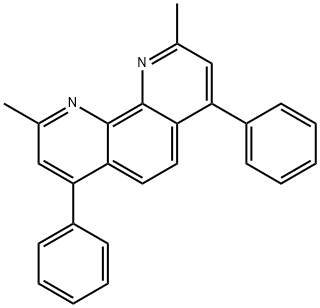
| Product Name: | Bathocuproine | | Synonyms: | Bathocuproine subliMed grade, 99.99% trace Metals basis;Bathocuproin SynonyMs 2,9-DiMethyl-4,7-diphenyl-1,10-phenanthroline;2,9-dimethyl-4,7-diphenyl-1,10-phenanthrolin;Bathocuproine (purified by sublimation);TIMTEC-BB SBB008863;2-DIMETHYL-4,7-DIPHENYL-1,10-PHENANTHROLINE;BATHOCUPROIN R. G.;BathocuproineGr | | CAS: | 4733-39-5 | | MF: | C26H20N2 | | MW: | 360.45 | | EINECS: | 225-240-5 | | Product Categories: | Industrial/Fine Chemicals;electronic;Electronic Chemicals;Analytical Chemistry;Chelating Reagents;Electroluminescence;Functional Materials;Highly Purified Reagents;Other Categories;Phenanthrolines;Refined Products by Sublimation;oled materials;fine chemicals, specialty chemicals, intermediates, electronic chemical, organic synthesis, functional materials | | Mol File: | 4733-39-5.mol |
| Bathocuproine Chemical Properties |
| Melting point | 279-283 °C(lit.) | | Boiling point | 482.47°C (rough estimate) | | density | 1.2408 (rough estimate) | | refractive index | 1.7620 (estimate) | | storage temp. | Sealed in dry,Room Temperature | | solubility | Benzene (Slightly, Heated), DMSO (Slightly, Heated), Methanol (Slightly, Heated) | | form | Powder | | pka | 5.88±0.30(Predicted) | | color | Yellow | | Water Solubility | Soluble in methanol (36mg/100ml), ethanol, 2-propanol, bezene, and acetone. Partly miscible in water. | | BRN | 306714 | | InChIKey | STTGYIUESPWXOW-UHFFFAOYSA-N | | CAS DataBase Reference | 4733-39-5(CAS DataBase Reference) | | EPA Substance Registry System | 1,10-Phenanthroline, 2,9-dimethyl-4,7-diphenyl- (4733-39-5) | | Odor | Light yellow powder |
| Bathocuproine Usage And Synthesis |
| Classification | Electron-transport layer materials, Electron-injection layer materials, Hole-blocking layer materials, OFET, OLED, Organic Photovoltaics, Perovskite solar cells, Sublimed materials. | | Applications | 2,9-Dimethyl-4,7-diphenyl-1,10-phenanthroline, also known as Bathocuproine (BCP), is a wide-band-gap material and has a high electron affinity. When it is embedded into organic electronic devices, bathocuproine acts as an exciton-blocking barrier which prohibits exciton diffusion process towards the Al electrode otherwise being quenched. One of the most commonly used buffer layer between acceptor and cathode layers is bathocuproine. The introduction of the buffer layer can greatly improve the PCE of polymer organic solar cells. BCP is one of the most popular hole-blocking layer materials that is used in organic electronics, including perovskite solar cells.
It was demonstrated that a BCP buffer layer reduces nonradiative recombination of excitons at the C60 –Al interface. Its most important function is to establish an Ohmic contact between the C60 film and the Al electrode in photovoltaic devices.
| | Description | Bathocuproine (BCP) is a wide-band-gap material and has a high electron affinity. When it is embedded into organic electronic devices, bathocuproine acts as an exciton-blocking barrier?which prohibits exciton diffusion process?towards the Al electrode otherwise being quenched. One of the most commonly used buffer layer between acceptor and cathode layers is?bathocuproine. The introduction of the buffer layer can greatly improve the PCE of polymer organic solar cells.?BCP is one of the most popular hole-blocking layer materials that is used in organic electronics, including perovskite solar cells. | | Chemical Properties | Yellow powder | | Uses | It is used as a reagent for the determination of copper. It acts as an exciton blocking barrier which prohibits excitons diffusion process towards the Al electrode otherwise being quenched. It is the most commonly used buffer layer between acceptor and cathode layer. | | Uses | Bathocuproine is used as a reagent for the determination of copper. It acts as an exciton blocking barrier which prohibits excitons diffusion process towards the Al electrode otherwise being quenched. It is the most commonly used buffer layer between acceptor and cathode layer. | | General Description | TGA/DSC Lot specific scans available upon request | | Purification Methods | Purify it by recrystallisation from *benzene. [Smith & Wilkins Anal Chem 25 510 1953, Beilstein 23 III/IV 2160.] |
| Bathocuproine Preparation Products And Raw materials |
|


 日本语
日本语 한국어
한국어 Français
 Deutsch
 España
 Türkiye