Other grades of this product :
| Acetonylacetone Chemical Properties |
| Melting point | -6--5 °C (lit.) | | Boiling point | 191 °C (lit.) | | density | 0.973 g/mL at 25 °C (lit.) | | vapor pressure | 0.43 mm Hg ( 20 °C) | | refractive index | n20/D 1.425(lit.) | | Fp | 174 °F | | storage temp. | Store below +30°C. | | solubility | alcohol: miscible | | form | Liquid | | color | Clear yellow to brown | | PH | 6.1 (10g/l, H2O, 20℃) | | explosive limit | 1.5%(V) | | Water Solubility | miscible | | Merck | 14,71 | | BRN | 506525 | | Stability: | Stable. Incompatible with strong bases, strong reducing agents, strong oxidizing agents. Flammable. | | InChIKey | OJVAMHKKJGICOG-UHFFFAOYSA-N | | CAS DataBase Reference | 110-13-4(CAS DataBase Reference) | | NIST Chemistry Reference | CH3COCH2CH2COCH3(110-13-4) | | EPA Substance Registry System | 2,5-Hexanedione (110-13-4) |
| Acetonylacetone Usage And Synthesis |
| Synthesis | 2,5-Hexanedione has been prepared in several ways. A common method involves hydrolysis of 2,5-dimethylfuran, a glucose derived heterocycle.
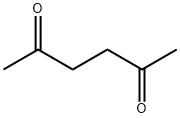
| | Mechanism of Toxicity | Identification of 2,5-hexanedione as the major neurotoxic metabolite of n-hexane proceeded rapidly after its discovery as a urinary metabolite. 2,5-Hexanedione has been found to produce a polyneuropathy indistinguishable from n-hexane. 2,5-Hexanedione is many times more potent than n-hexane, the parent compound, in causing neurotoxicity in experimental animals. It appears that the neurotoxicity of 2,5-hexanedione resides in its γ-diketone structure since 2,3-, 2,4-hexanedione and 2,6-heptanedione are not neurotoxic, while 2,5-heptanedione and 3,6-octanedione and other γ-diketones are neurotoxic.
| | Chemical Properties | colourless to pale yellow liquid | | Uses | It is the metabolite implicated in n-hexane neurotoxicity. | | Uses | 2,5-Hexanedione is used as a reagent in the preparation of trans-2,5-dimethylpyrrolidine. It is also used in the synthesis of 2,5-dimethylpyrroles. Further, it plays an important role as a reagent used for the protection of amino groups in amino sugars and nucleosides. In addition to this, it is used in the preparation of five-membered heterocycles like indane-type and benzannulated systems. It is also employed as a precursor in Diels-alder cycloaddition reactions. | | Uses | It was used as reference standard for the determination of 2,5HD in human urine using gas chromatography-electron capture detection and gas chromatography-mass selective detection. | | Definition | ChEBI: A diketone that is hexane substituted by oxo groups at positions 2 and 5. It is a toxic metabolite of hexane and of 2-hexanone
| | Synthesis Reference(s) | Canadian Journal of Chemistry, 59, p. 945, 1981 DOI: 10.1139/v81-137Journal of the American Chemical Society, 105, p. 7200, 1983 DOI: 10.1021/ja00362a047Tetrahedron Letters, 15, p. 4149, 1974 | | General Description | Clear colorless to amber liquid with a sweet aromatic odor. | | Air & Water Reactions | Highly flammable. Water soluble. | | Reactivity Profile | Acetonylacetone is incompatible with oxidizing agents. Acetonylacetone is also incompatible with strong bases and strong reducing agents. | | Fire Hazard | Acetonylacetone is combustible. | | Purification Methods | Purify it by dissolving in Et2O, stiring with K2CO3 (a quarter of the weight of dione), filtering, drying over anhydrous Na2SO4 (not CaCl2), filtering again, evaporating the filtrate and distilling it in a vacuum. It is then redistilled through a 30cm Vigreux column (p 11, oil bath temperature 150o). It is miscible with H2O and EtOH. The dioxime has m 137o (plates from *C6H6), the mono-oxime has b 130o/11mm, and the 2,4-dinitrophenylhydrazone has m 210-212o (red needles from EtOH). It forms complexes with many metals. [Werner et al. Chem Ber 22 2100 1989, for enol content see Gero J Org Chem 19 1960 1954, Beilstein 1 IV 3688.] |
| Acetonylacetone Preparation Products And Raw materials |
| Raw materials | Potassium carbonate-->2,3-Butanedione-->2,5-Dimethylfuran-->ETHYL ACETOACETATE SODIUM SALT-->IODINE PURE-->3-HEXENE-2,5-DIONE-->(2R,3S,4S,5R)-2,5-Bis(hydroxymethyl)-oxolane-2,3,4-triol-->5-Chloromethylfurfural-->5-Methyl furfural-->2,5-Hexanediol | | Preparation Products | Ascorbic Acid-->Methyl 3-methyl-2-butenoate-->2,5-Dimethyl-1H-pyrrole-->1-[2,6-DICHLORO-4-(TRIFLUOROMETHYL)PHENYL]-2,5-DIMETHYL-1H-PYRROLE-3-CARBALDEHYDE-->2,5-Dimethylthiophene-->5-Methylisoxazole-3-carboxylic acid-->Tetrahydropyran-->2,5-DIMETHYL-1-PHENYLPYRROLE-->1-(4-CYANOPHENYL)-2,5-DIMETHYLPYRROLE |
|


 日本语
日本语 한국어
한국어 Français
 Deutsch
 España
 Türkiye