Other grades of this product :
| Trimethylsilylacetylene Chemical Properties |
| Melting point | >0°C | | Boiling point | 53 °C(lit.) | | density | 0.695 g/mL at 25 °C(lit.) | | vapor pressure | 4.18 psi ( 20 °C) | | refractive index | n20/D 1.388(lit.) | | Fp | <−30 °F | | storage temp. | Store below +30°C. | | solubility | Miscible with organic solvents. | | form | liquid | | color | colorless | | Specific Gravity | 0.695 | | Water Solubility | reacts | | Hydrolytic Sensitivity | 4: no reaction with water under neutral conditions | | BRN | 906752 | | InChIKey | CWMFRHBXRUITQE-UHFFFAOYSA-N | | CAS DataBase Reference | 1066-54-2(CAS DataBase Reference) | | NIST Chemistry Reference | (Trimethylsilyl)acetylene(1066-54-2) | | EPA Substance Registry System | Trimethylsilylacetylene (1066-54-2) |
| Hazard Codes | F,Xi | | Risk Statements | 11-36/37/38 | | Safety Statements | 16-26-36 | | RIDADR | UN 1993 3/PG 2 | | WGK Germany | - | | Hazard Note | Flammable/Irritant | | TSCA | T | | HazardClass | 3 | | PackingGroup | II | | HS Code | 29310095 |
| Trimethylsilylacetylene Usage And Synthesis |
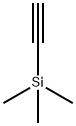
| Silican-protected group | Trimethylsilylacetylene is a silican-protected group, also known as trimethylethynylsilane, trimethylethynyl silicon and ethynyltrimethylsilane. It is a colorless transparent liquid at room temperature. It could be used to synthesize parazole by the addition of 1,3-bipolar ring of acetylene diazide. It is also the substrate of nickel catalyzed reaction and benzonitrile coupling reaction. | | Application |
- Common intermediate for asymmetric synthesis
- Silica reagent
| | Chemical Properties | CLEAR COLORLESS LIQUID | | Physical properties | bp 53 °C; d 0.695 g cm?3. | | Uses | (Trimethylsilyl)acetylene is used in the preparation of trimethylsilanyl-propiolic acid ethyl ester by reacting with carbonochloridic acid ethyl ester as well as in the synthesis of iodoalkenes by radical addition of perfluoroalkyl iodides. It is used as a nucleophile in Friedel-Crafts type acylations and alkylations reactions, as a ligand in organometallic chemistry and an useful reagent in cycloaddition reactions. It acts as a precursor to lithium trimethylsilylacetylide It finds application in the synthesis of (±)-estrone. | | Uses | Ethynyltrimethylsilane was used in:
? microwave-assisted, one-pot, three-step Sonogashira cross-coupling-desilylation-cycloaddition reaction for the preparation of 1,4-disubstituted 1,2,3-triazoles
synthesis of poly(ethynyltrimethylsilane) containing Pd (II) coordination sites
pyrazole synthesis via 1,3-dipolar cycloaddition of diazo compounds to acetylenes | | Uses | Trimethylsilylacetylene is a valuable reagent used in ethynylation by palladium(0)-catalyzed coupling/condensation
with aryl and vinyl halides and triflates, or by nucleophilic attack
of the corresponding acetylide on electrophilic centers; reacts with alkyl iodides, tin hydrides,6 and dichloroketene in a
regioselective and stereoselective manner, participating in the following synthesis reactions: Ethynylations, Palladium(0)-Catalyzed Coupling Reactions,Reaction of Trimethylsilylacetylides with Electrophiles, Radical-Initiated and Transition Metal-Catalyzed Additions, Cycloaddition Reactions, Ethynylations, Cycloaddition Reactions, Further Transformations etc. | | General Description | Laser-induced polymerization of gaseous ethynyltrimethylsilane was used for efficient chemical vapour deposition of polycarbosilane films. Ethynyltrimethylsilane acts as substrate for nickel-catalyzed cross-coupling with benzonitriles. | | Purification Methods | Distil it through an efficient column. The IR has bands at max 2041 (CC) and 3289 (C-H) cm-1. [Kr.hnke & Goss Chem Ber 92 30 1959, Beilstein 4 IV 3937.] |
| Trimethylsilylacetylene Preparation Products And Raw materials |
|


 日本语
 한국어
 Français
 Deutsch
 España
 Türkiye