| Chemical Properties | clear colorless to pale yellow liquid |
| Chemical Properties | Ethyl Propionate is found in many
fruits and alcoholic beverages. It has a fruity odor reminiscent of rum and is used
in flavor compositions for creating both fruity and rum notes. |
| Chemical Properties | Ethyl propionate has an odor reminiscent of rum and pineapple. |
| Occurrence | Reported found in several types of wine, in white grape var. Sauvignon, cocoa, apple juice, orange juice, grapefruit juice, guava, melon, peach, pineapple, strawberry, tomato, various cheeses, beer, cognac, rum, whiskey, bourbon, malt whiskey,
scotch, cider, brandy, kiwi fruit and mussels. |
| Uses | Ethyl Propionate is a flavoring agent that is a transparent liquid,
colorless, with an odor resembling rum. it is miscible in alcohol and
propylene glycol, soluble in fixed oils, mineral oil, and alcohol, and
sparingly soluble in water. it is obtained by chemical synthesis. |
| Uses | Solvent for cellulose ethers and esters, various
natural and synthetic resins; flavoring agent; fruit
syrups; cutting agent for pyroxylin. |
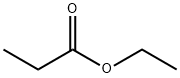
| Definition | ChEBI: A propanoate ester of ethanol. |
| Preparation | From propionic acid, ethyl alcohol and concentrated H2SO4 in chloroform at the boil |
| Production Methods | Ethyl propionate is produced by the esterification of ethyl
alcohol with propionic acid or propionic anhydride. |
| Aroma threshold values | Detection: 9 to 45 ppb |
| Taste threshold values | Taste characteristics at 25 ppm: sharp, fermented, rummy and fruity. |
| General Description | A clear colorless liquid with a pineapple-like odor. Flash point 54°F. Less dense than water and insoluble in water. Vapors are heavier than air. |
| Air & Water Reactions | Highly flammable. Insoluble in water. |
| Reactivity Profile | Ethyl propionate is an ester. Esters react with acids to liberate heat along with alcohols and acids. Strong oxidizing acids may cause a vigorous reaction that is sufficiently exothermic to ignite the reaction products. Heat is also generated by the interaction of esters with caustic solutions. Flammable hydrogen is generated by mixing esters with alkali metals and hydrides. Can react with oxidizing agents, bases, and acids. Polymerization: Will not polymerize [USCG, 1999]. |
| Hazard | Flammable, dangerous fire risk. |
| Health Hazard | Exposure can cause irritation of eyes, nose and throat. May cause shortness of breath or coughing. High concentrations have a narcotic effect. May cause abdominal pain and vomiting if swallowed. |
| Safety Profile | Moderately toxic by
ingestion and intraperitoneal routes. A skin
and eye irritant. A flammable liquid. A very
dangerous fire and explosion hazard when
exposed to heat or flame; can react
vigorously with oxidizing materials. To fight
fire, use foam, CO2, dry chemical. When
heated to decomposition it emits acrid smoke and irritating fumes. See also
ETHERS. |
| Purification Methods | Treat the ester with anhydrous CuSO4 and distil it under nitrogen. [Beilstein 2 IV 205.] |


 日本语
日本语 한국어
한국어 Français
 Deutsch
 España
 Türkiye