Other grades of this product :
| Glycidyl methacrylate Basic information |
| Glycidyl methacrylate Chemical Properties |
| Glycidyl methacrylate Usage And Synthesis |
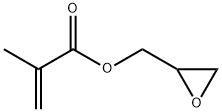
| Chemical Properties | Glycidyl methacrylate (GMA) is a colorless liquid with a fruity odor. Floats on water. (USCG, 1999)
Glycidyl methacrylate is a polyfunctional monomer. It acts as an adhesion promoting crosslinking co-monomer for acrylic and vinyl resins. It is also a reactive colorless diluent. GMA is soluble in ethanol, acetone, diethyl ether, benzene.
| | Uses | Glycidyl methacrylate (GMA) is a common monomer used in the creation of epoxy resins. It is used to provide epoxy functionalization to polyolefins and other acrylate resins.
Glycidyl methacrylate is used in the production of polymer coatings and finishes, adhesives, plastics and elastomers.
Glycidyl methacrylate dextran has been reported to be used as a biocompatible hydrogel. In situ polymerization of GMA with trimethylolpropane trimethacrylate to form macroporous sorbents has also been reported. GMA may also be grafted onto polypropylene. | | Uses | Glycidyl methacrylate is commonly used as a monomer for the preparation of epoxy resins. It is also used to provide epoxy functionalization to polyolefins and other acrylate resins. Further, it is also useful as an epoxy resin additive for paint coating formulations and adhesive applications. | | Uses | Glycidyl methacrylate dextran (GMA) has been reported to be used as a biocompatible hydrogel. In situ polymerization of GMA with trimethylolpropane trimethacrylate to form macroporous sorbents has also been reported. GMA may also be grafted onto polypropylene. | | Preparation | Glycidyl methacrylate is produced from methacrylic acid and glycidol. Glycidol contain both epoxide and alcohol functional groups.It is an enoate ester and an epoxide. It derives from a methacrylic acid and a glycidol. | | Reactions | Glycidyl methacrylate (GMA) is a kind of functional monomer. Its active vinyl and epoxy groups could be grafted with polyolefin and reacted with the polar groups such as amine, hydroxyl and carboxyl group, respectively. It can also undergo polymerization to form poly (glycidyl methacrylate). | | Synthesis Reference(s) | Tetrahedron, 48, p. 5099, 1992 DOI: 10.1016/S0040-4020(01)90120-6Synthesis, p. 1019, 1986 DOI: 10.1055/s-1986-31856 | | General Description | Colorless liquid with a fruity odor. Floats on water. | | Air & Water Reactions | Flammable. Slightly water soluble. | | Reactivity Profile | Epoxides, such as Glycidyl methacrylate, are highly reactive. They polymerize in the presence of catalysts or when heated. These polymerization reactions can be violent. Compounds in this group react with acids, bases, and oxidizing and reducing agents. They react, possibly violently with water in the presence of acid and other catalysts. | | Health Hazard | The liquid irritates eyes about as much as soap. Prolonged contact with skin produces irritation and dermatitis. | | Fire Hazard | Special Hazards of Combustion Products: Irritating vapors are generated when heated | | Flammability and Explosibility | Flammable |
| Glycidyl methacrylate Preparation Products And Raw materials |
|


 日本语
日本语 한국어
한국어 Français
 Deutsch
 España
 Türkiye