Other grades of this product :
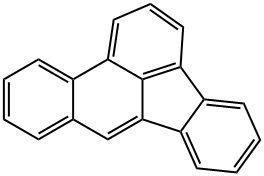
| BENZO(B)FLUORANTHENE Basic information |
| BENZO(B)FLUORANTHENE Chemical Properties |
| Melting point | 163-165 °C(lit.) | | Boiling point | 481°C(lit.) | | density | 1.1549 (estimate) | | vapor pressure | 5 x 10⁻⁷ mmHg at 20 °C (U.S. EPA, 1982) | | refractive index | 1.8390 (estimate) | | Fp | -18 °C | | storage temp. | 2-8°C | | solubility | Soluble in most solvents (U.S. EPA, 1985) | | pka | >15 (Christensen et al., 1975) | | form | neat | | color | White to Yellow to Green | | Water Solubility | 1.2 μg/L at 25 °C (U.S. EPA, 1980a) | | BRN | 1872553 | | Henry's Law Constant | 2.47, 5.03, 11.74, 14.90, 20.53, and 36.52 at 10.0, 20.0, 35.0, 40.1, 45.0, and 55.0 °C, respectively
(wetted-wall column, ten Hulscher et al., 1992) | | Stability: | Stable. Incompatible with strong oxidizing agents. | | CAS DataBase Reference | 205-99-2(CAS DataBase Reference) | | IARC | 2B (Vol. 92) 2010 | | EPA Substance Registry System | Benzo[b]fluoranthene (205-99-2) |
| BENZO(B)FLUORANTHENE Usage And Synthesis |
| Chemical Properties | off-white to tan powder | | Chemical Properties | Benzo(b)fluoranthene is a colorless, needleshaped
solid. | | Physical properties | Colorless to pale yellow to yellow-orange needles or crystals from benzene, toluene, ethylbenzene
or acetic acid. | | Uses | Benz[e]acephenanthrylene is a polycyclic aromatic hydrocarbon that was detected in significant levels in airborne polluants, auto exhaust and tobacco and marijuana smoke. | | Definition | ChEBI: An ortho- and peri-fused polycyclic arene that consists of a benzene ring fused with a acephenanthrylene ring. | | Synthesis Reference(s) | Tetrahedron Letters, 36, p. 2403, 1995 DOI: 10.1016/0040-4039(95)00314-3 | | General Description | Needles or yellow fluffy powder. | | Air & Water Reactions | Insoluble in water. | | Reactivity Profile | BENZO(B)FLUORANTHENE can react with strong oxidizing agents. May react with electrophiles, peroxides, nitrogen oxides and sulfur oxides | | Hazard | Confirmed carcinogen. | | Health Hazard | Acute oral toxicity data are not available.There is sufficient evidence on the carcinogenicity of this compound in animals. Itproduced tumors at the site of application.Cancers in lungs and skin have been observedin animals. | | Health Hazard | ACUTE/CHRONIC HAZARDS: When heated to decomposition, BENZO(B)FLUORANTHENE emits acrid smoke and irritating fumes. | | Fire Hazard | Flash point data for BENZO(B)FLUORANTHENE are not available; however, BENZO(B)FLUORANTHENE is probably combustible. | | Safety Profile | Confirmed carcinogen
with experimental carcinogenic and
tumorigenic data. Mutation data reported.
When heated to decomposition it emits
acrid smoke and irritating fumes. | | Potential Exposure | There is no commercial production of
this compound. Benzo(b)fluoranthene is a chemical substance
formed during the incomplete burning of fossil fuel,
garbage, in cigarette smoke, or any organic matter and is
Benzofluoranthene 399
found in smoke in general; it is carried into the air, where
it condenses onto dust particles and is distributed into water
and soil and on crops. B(b)F is a PAH and a component of
coal tar pitch used in industry as a binder for electrodes. It
is also a component of creosote, which is used to preserve
wood. PAHs are also found in limited a mounts in bituminous
materials and asphalt used for paving, roofing, and
insulation. B(b)F has some use as a research chemical. It is
available from some specialty chemical firms in low quantities
(25 100 mg). | | Carcinogenicity | Benzo[b]fluoranthenewas tested
for carcinogenicity by dermal application in mice in multiple
studies, intraperitoneal injection into mice
in multiple studies, and intrapulmonary
implantation into rats in one study. In all of these studies,
benzo[b]-fluoranthene exhibited a significant carcinogenic
activity. | | Source | Benzo[b]fluoranthene and benzo[k]fluoranthene were detected in 8 diesel fuels at
concentrations ranging from 0.0027 to 3.1 mg/L with a mean value of 0.266 mg/L (Westerholm
and Li, 1994). Also present in low octane gasoline (0.16–0.49 mg/kg), high octane gasoline (0.26–
1.34 mg/kg), used motor oil (2.8–141.0 mg/kg), and bitumen (40 to 1,600 ppb), cigarette smoke (3
g/1,000 cigarettes), and gasoline exhaust (19 to 48 g/L) (quoted, Verschueren, 1983). Also
detected in asphalt fumes at an average concentration of 22.04 ng/m3 (Wang et al., 2001).
Nine commercially available creosote samples contained benzo[b]fluoranthene at concentrations
ranging from 2 to 96 mg/kg (Kohler et al., 2000).
Schauer et al. (2001) measured organic compound emission rates for volatile organic
compounds, gas-phase semi-volatile organic compounds, and particle phase organic compounds
from the residential (fireplace) combustion of pine, oak, and eucalyptus. The particle-phase
emission rates of benzo[b]fluoranthene were 0.790 mg/kg of pine burned, 0.400 mg/kg of oak
burned, and 0.327 mg/kg of eucalyptus burned.
Particle-phase tailpipe emission rate from a noncatalyst-equipped gasoline-powered automobile
was 37.3 μg/km (Schauer et al., 2002). | | Environmental fate | Biological. Ye et al. (1996) investigated the ability of Sphingomonas paucimobilis strain U.S.
EPA 505 (a soil bacterium capable of using fluoranthene as a sole source of carbon and energy) to
degrade 4, 5, and 6-ringed aromatic hydrocarbons (10 ppm). After 16 h of incubation using a
resting cell suspension, only 12.5% of benzo[b]fluoranthene had degraded. It was suggested that
degradation occurred via ring cleavage resulting in the formation of polar metabolites and carbon
dioxide.
Soil. The reported half-lives for benzo[b]fluoranthene in a Kidman sandy loam and McLaurin
sandy loam are 294 and 211 d, respectively (Park et al., 1990).
Photolytic. The atmospheric half-life was estimated to range from 1.43 to 14.3 h (Atkinson,
1987).
Chemical/Physical. Benzo[b]fluoranthene will not hydrolyze because it has no hydrolyzable
functional group (Kollig, 1993). | | Shipping | UN2811 Toxic solids, organic, n.o.s., Hazard
Class: 6.1; Labels: 6.1—Poisonous materials, Technical
Name Required. | | Incompatibilities | Incompatible with oxidizers (chlorates,
nitrates, peroxides, permanganates, perchlorates, chlorine,
bromine, fluorine, etc.); contact may cause fires or explosions.
Keep away from alkaline materials, strong bases,
strong acids, oxoacids, epoxides. | | Waste Disposal | Residues and sorbent media
may be packaged in 17H epoxy-lined drums and disposed
of at an EPA-approved site. Destroy by permanganate oxidation,
high-temperature incineration with scrubbing equipment,
or microwave plasma treatment, if available.
Confirm disposal procedures with responsible environmental
engineer and regulatory officials. |
| BENZO(B)FLUORANTHENE Preparation Products And Raw materials |
|


 日本语
日本语 한국어
한국어 Français
 Deutsch
 España
 Türkiye