Other grades of this product :
| Diphenolic acid Basic information |
| Diphenolic acid Chemical Properties |
| Melting point | 167-170 °C(lit.) | | Boiling point | 388.69°C (rough estimate) | | density | 1.30 | | refractive index | 1.5450 (estimate) | | Fp | 208°C | | storage temp. | Inert atmosphere,Room Temperature | | solubility | DMSO (Slightly), Methanol (Slightly) | | form | Solid | | pka | 4.66±0.10(Predicted) | | color | White to Off-White | | Merck | 14,3312 | | BRN | 1886361 | | InChIKey | VKOUCJUTMGHNOR-UHFFFAOYSA-N | | CAS DataBase Reference | 126-00-1(CAS DataBase Reference) | | EPA Substance Registry System | Diphenolic acid (126-00-1) |
| Diphenolic acid Usage And Synthesis |
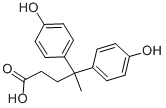
| Chemical Properties | Light pink solid | | Uses | Diphenolic acid (DPA) has been identified as a potential replacement for bisphenol A, which is one of the monomers for epoxy resins and polycarbonates. DPA also can Intermediate for surface coatings, lubricating oil additives, cosmetics, surfactants, plasticizers, textile chemicals. | | Uses | Diphenolic Acid is a flux compound. Adhesives for semiconductor devices. | | Uses | Since diphenolic acid is a close structural analog of bisphenol A, diphenolic acid has the potential to displace bisphenol A. A possible endocrine disruptor, bisphenol A is used in polymer applications such as for use in baby bottles, dental resins, and lacquers to coat food cans. | | Preparation | Diphenolic acid (DPA) can be made by the condensation reaction of levulinic acid with phenol in the presence of acid catalysts.
Synthesis of diphenolic acid from levulinic acid
| | Industrial uses | Diphenolic acid, the condensation product of levulinic acid and phenol, is useful in the preparation of the modified phenol formaldehyde resins, polyether resins and as monocarboxilic acid chain stopper in alkyd resin (Bader, 1960). | | Purification Methods | When recrystallised from *C6H6, the crystals have 0.5 mol of *C6H6 (m 120-122o), and when recrystallised from toluene, the crystals have 0.5 mol of toluene. Purify the acid by recrystallisation from hot H2O. It is soluble in Me2CO, AcOH, EtOH, propan-2-ol, methyl ethyl ketone. It can also be recrystallised from AcOH, heptane/Et2O or Me2CO/*C6H6. It has max 225 and 279nm in EtOH. The methyl ester has m 87-89o (aqueous MeOH to give the trihydrate). [Bader & Kantowicz J Am Chem Soc 76 4465 1954, Beilstein 10 IV 1890.] |
| Diphenolic acid Preparation Products And Raw materials |
|


 日本语
日本语 한국어
한국어 Français
 Deutsch
 España
 Türkiye