Other grades of this product :
| tert-Butyldimethylsilyl chloride Basic information |
| tert-Butyldimethylsilyl chloride Chemical Properties |
| Melting point | 86-89 °C (lit.) | | Boiling point | 125 °C (lit.) | | density | 0.87 g/mL at 20 °C(lit.) | | vapor pressure | 60-710Pa at 25℃ | | refractive index | n20/D 1.46 | | Fp | 73 °F | | storage temp. | Store below +30°C. | | solubility | very sol nearly all common organic solvents such as
THF, methylene chloride, and DMF. | | form | white solid | | Specific Gravity | 1.225 | | color | white | | Water Solubility | Soluble in chloroform and ethyl acetate. Insoluble in water. | | Hydrolytic Sensitivity | 7: reacts slowly with moisture/water | | Sensitive | Moisture Sensitive | | BRN | 505999 | | Exposure limits | ACGIH: TWA 20 ppmOSHA: Ceiling 300 ppm; TWA 200 ppmNIOSH: IDLH 500 ppm; TWA 100 ppm(375 mg/m3); STEL 150 ppm(560 mg/m3) | | InChIKey | BCNZYOJHNLTNEZ-UHFFFAOYSA-N | | LogP | 2.5 at 20℃ | | CAS DataBase Reference | 18162-48-6(CAS DataBase Reference) | | NIST Chemistry Reference | Silane, chloro(1,1-dimethylethyl)dimethyl-(18162-48-6) | | EPA Substance Registry System | Silane, chloro(1,1-dimethylethyl)dimethyl- (18162-48-6) |
| tert-Butyldimethylsilyl chloride Usage And Synthesis |
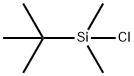
| Chemical Properties | tert-Butyldimethylsilyl chloride is a colorless or white solid that is soluble in many organic solvents but reacts with water and alcohols.It is an organosilicon compound that can be used as a versatile protecting reagent for alcohols, amines, amides, and various carboxylic acids. | | Uses | tert-Butyldimethylchlorosilane is used to protect hydroxyl group in organic synthesis. It finds application in the synthesis of prostaglandin. It is also used as an auxiliary material for hypolipaemics such as lovastatin and simvastatin. It plays an important role in the preparation of isoxazolines N-oxides from alpha-bromonitroalkanes. It acts as a versatile protecting reagent for amines, amides and alcohols. | | Preparation | tert-butyldimethylsilyl chloride (TBSCI) was synthesized by the reaction of tert-butyllithium with dichlorodimethylsilane.The pentane solution of dichlorodimethylsilane was cooled to 0°C, and the pentane solution of tert-butyllithium was added dropwise with stirring under nitrogen. The temperature was maintained at 0 °C, stirred for 1.5 h and then heated to 25 °C, and the reaction was continued for 48 h. Distillation, collect 125 ℃ (97.5kPa) fractions, stand to solidify, and obtain tert-butyldimethylsilyl chloride. Yield 70%. | | Definition | ChEBI: Tert-butyldimethylsilyl chloride is a silyl chloride consisting of a central silicon atom covalently bound to one chloro, one tert-butyl and two methyl groups. tert-Butyldimethylsilyl chloride is a derivatisation agent used in gas chromatography/mass spectrometry applications. It has a role as a chromatographic reagent. | | Application | Tert-butyldimethylsilyl chloride is a sterically hindered organosilicon protective agent, which is widely used in the synthesis of original drugs. It is used as a protective group for hydroxyl in the synthesis of ribonucleosides, and is also an oxidant and decyanide.t-Butyldimethylchlorosilane is useful as an anion trapping reagent. For example, TBDMSCl was found to be an efficient trap of the lithio α-phenylthiocyclopropane anion.When dichlorothiophene was treated with 2 equiv of n-butyllithium followed by 2 equiv of TBDMSCl the di-TBDMS-thiophene was isolated. The lithium anions of primary (eq 1) and secondary (eq 2) nitriles were trapped with TBDMSCl to give C,N-disilyl- and Nsilylketenimines in excellent yields.Silyl stannanes have been prepared by trapping tin anions with TBDMSCl or other silyl chlorides. Alkynes treated with silyl stannanes and catalytic tetrakis(triphenylphosphine)palladium(0) give cis-silyl stannylalkenes in good yields. | | Reactions | tert-Butyldimethylsilyl chloride reacts with alcohols in the presence of base to give tert-butyldimethylsilyl ethers:(Me3C)Me2SiCl + ROH → (Me3C)Me2SiOR + HClThese silyl ethers hydrolyze much more slowly than the trimethylsilyl ethers. | | Hazard | Moderately toxic. | | Flammability and Explosibility | Flammable | | Purification Methods | Fractionally distil it at atmospheric pressure. [Sommer & Tyler J Am Chem Soc 76 1030 1954, Corey & Venkateswarlu J Am Chem Soc 94 6190 1972, Beilstein 4 IV 4076.] |
| tert-Butyldimethylsilyl chloride Preparation Products And Raw materials |
|


 日本语
日本语 한국어
한국어 Français
 Deutsch
 España
 Türkiye