Other grades of this product :
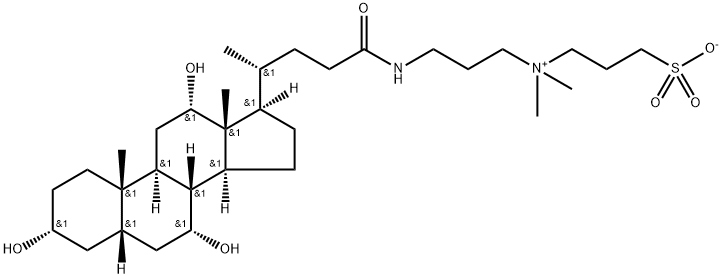
| Product Name: | CHAPS | | Synonyms: | CHAPS;CHAPS (3-((3-CHOLAMIDOPROPYL)DIMETHYLAMMONIO)PROPANESULFONATE);3-[(3-CHOLAMIDOPROPYL)DIMETHYLAMMONIO]-1-PROPANE SULPHONATE (ULTRAPURE);3-[(3-CHOLAMIDOPROPYL)DIMETHYLAMMONIO]PROPANESULFONAT(CHAPS);3-[(3-Cholamidopropyl)dimethylammonio]-1-propanesulphonate (Ultrapure) >99.0%;CHAPS, 98+%;CHAPS extrapure;1-Propanaminium, N,N-dimethyl-N-(3-sulfopropyl)-3-[[(3a,5b,7a,12a)-3,7,12-trihydroxy-24-oxocholan-24-yl]amino]-, inner salt | | CAS: | 75621-03-3 | | MF: | C32H58N2O7S | | MW: | 614.88 | | EINECS: | 616-246-2 | | Product Categories: | Miscellaneous Biochemicals;Surfactants;Amphoteric Surfactants;Amphoteric Surfactants (for Biochemistry);Betaine Type (Surfactants);Detergents;Bile Acids;Surfactants (for Biochemistry);Ammonium Polyhalides, etc. (Quaternary);Biochemistry;Functional Materials;Quaternary Ammonium Compounds;Steroids;Buffer;detergent | | Mol File: | 75621-03-3.mol |
| CHAPS Chemical Properties |
| Melting point | 156-158°C (dec.) | | density | 1.01 g/mL at 20 °C | | refractive index | 1.6900 (estimate) | | storage temp. | -20°C | | solubility | H2O: 50 mg/mL at 20 °C, clear, colorless | | form | Crystalline Powder | | color | White | | Odor | Odorless | | PH Range | 6 | | Water Solubility | Soluble in water (10 mg/ml). Soluble in DMF and hot methanol. | | Sensitive | Hygroscopic | | Merck | 2044 | | Stability: | Moisture Sensitive: Hydroscopic | | InChIKey | UMCMPZBLKLEWAF-RFCNGIAKSA-N |
| CHAPS Usage And Synthesis |
| Chemical Properties | White crystalline powder. CHAPS may be synthesized from cholic acid and is zwitterionic due to its quaternary ammonium and sulfonate groups; it is structurally similar to certain bile acids, such as taurodeoxycholic acid and taurochenodeoxycholic acid. It is sparingly soluble or insoluble in aqueous solution due to their native hydrophobicity. | | Uses | CHAPS is a zwitterionic nondenaturing detergent for solubilizing membrane proteins. It is used in the laboratory to dissolve biological macromolecules such as proteins. It acts as a non-denaturing solvent used in purification of membrane proteins. It is also useful in conjunction with nonionic detergents like Triton X-100. Further, it is used as a non-denaturing zwitterionic detergent for membrane biochemistry. | | Application | CHAPS is often used as a detergent in the solubilization and purification of membrane proteins for several advantageous reasons. CHAPS detergent is non-denaturing to membrane proteins, can solubilize proteins, disaggregate protein-protein interactions. CHAPS is also useful in ion exchange chromatography and isoelectric focusing as it is zwitterionic and does not exhibit a net charge between pH 2 to 12. It is suitable for isolation of membrane proteins with the following features such as sufficient protein solubilization capability, no denaturing or inactivation of proteins, no interference with protein activities, no precipitation at 4°C, appropriate critical micelle concentrations (CMC) and micelle size, no absorption in the UV region, no toxicity and availability of detergent detection methods. | | General Description | CHAPSis a stabilizing agent that can be used to prevent aggregation, precipitation or proteolysis of proteins in solution. | | Biological Activity | CHAPS is a zwitterionic nondenaturing detergent for solubilizing membrane proteins. Combines the properties of both the sulfobetaine-type and bile-acid detergents. | | Purification Methods | Triturate this zwitterionic detergent (~50g) with MeOH (200ml), then triturate it with Me2CO (500mL), collect it by vacuum filtration and dry it thoroughly at ~20o. Recrystallise it at 0o from absolute MeOH followed by drying in vacuo to constant weight. It should give one spot with RF 0.32 by TLC on silica gel G in 95% MeOH/5% NH4OH and visualized with iodine vapour; the tertiary amine precursor has RF 0.40. It has low UV absorption (1% in H2O: A280nm is 0.029 and A260nm is 0.035), and the CMC (critical micellar concentration) is 8mM. It is soluble in H2O, MeOH, Me2SO but insoluble in Me2CO, MeCN, hexane, toluene and xylene. [Hjelmeland et al. Anal Biochem 130 72 1983, Matuo et al. Methods Enzymol 198 155 1991.] CHAPSO (3-[(3-cholamidopropyl)dimethylammonio]-1-propanesulfonate betaine) [82473-24-3] M 630.89, m 184-196o, [ ] D +19o (c 2, H2O), pKEst (1) ~<2 (acidic), pKEst(2) ~9 (basic). Dissolve this zwitterionic detergent (~ 60g) in 40% aqueous MeOH and stir it with the mixed-bed ion-exchange resin RG-501 x 8 (100g, Bio-Rad) until the pH of the supernatant is ~ 7. Filter off the resin and evaporate the filtrate to dryness under reduced pressure. Check for homogeneity by TLC on silica gel G in 95% MeOH/5% NH4OH and visualize the spot with iodine vapour (see CHAPS above). [Hjelmeland et al. Anal Biochem 130 72 1983, Matuo et al. Methods Enzymol 198 155 1991.] |
| CHAPS Preparation Products And Raw materials |
|


 日本语
日本语 한국어
한국어 Français
 Deutsch
 España
 Türkiye