Other grades of this product :
| LAURIC ACID DIETHANOLAMIDE Basic information |
| LAURIC ACID DIETHANOLAMIDE Chemical Properties |
| Melting point | 45-48℃ | | Boiling point | 429.73°C (rough estimate) | | density | 0.9610 (rough estimate) | | vapor pressure | 0.002Pa at 20℃ | | refractive index | 1.4545 (estimate) | | storage temp. | -20°C Freezer | | solubility | Chloroform (Slightly), Methanol (Slightly) | | form | Solid | | pka | 14.13±0.10(Predicted) | | color | White to Off-White | | Water Solubility | 49.91mg/L at 20℃ | | LogP | 3.48 | | CAS DataBase Reference | 120-40-1(CAS DataBase Reference) | | EPA Substance Registry System | Lauric diethanolamide (120-40-1) |
| LAURIC ACID DIETHANOLAMIDE Usage And Synthesis |
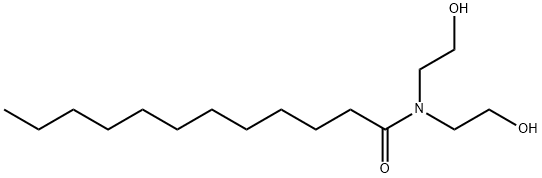
| Uses | N,N-Bis(2-hydroxyethyl)dodecanamide is used in preparation method of water-absorbent resin for improving anti-caking performance. | | General Description | Off-white waxy solid. | | Air & Water Reactions | Insoluble in water. | | Reactivity Profile | An alcohol and amide. Flammable and/or toxic gases are generated by the combination of alcohols with alkali metals, nitrides, and strong reducing agents. They react with oxoacids and carboxylic acids to form esters plus water. Oxidizing agents convert them to aldehydes or ketones. Alcohols exhibit both weak acid and weak base behavior. They may initiate the polymerization of isocyanates and epoxides. Organic amides/imides react with azo and diazo compounds to generate toxic gases. Flammable gases are formed by the reaction of organic amides/imides with strong reducing agents. Amides are very weak bases (weaker than water). Imides are less basic yet and in fact react with strong bases to form salts. That is, they can react as acids. Mixing amides with dehydrating agents such as P2O5 or SOCl2 generates the corresponding nitrile. The combustion of these compounds generates mixed oxides of nitrogen (NOx). | | Fire Hazard | Flash point data for LAURIC ACID DIETHANOLAMIDE are unavailable, however, LAURIC ACID DIETHANOLAMIDE is probably combustible. | | Flammability and Explosibility | Nonflammable |
| LAURIC ACID DIETHANOLAMIDE Preparation Products And Raw materials |
|


 日本语
日本语 한국어
한국어 Français
 Deutsch
 España
 Türkiye