Other grades of this product :
| Ibandronic acid Basic information |
| Ibandronic acid Chemical Properties |
| Ibandronic acid Usage And Synthesis |
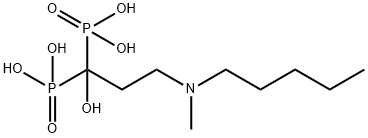
| Description | This third generation biphosphonate was launched in Austria and Germany
for the treatment of bone disorders such as hypercalcemia in malignancy and
ostedysis, Paget's disease and osteoporosis. It does not effect bone mineralization,
therefore, the potential risk of osteomalacia is prevented. This was a problem with
first generation derivatives. While the exact mode of action is not understood, they
are inhibitors of osteroclast mediated bone resorption. These compounds strongly
interact with hydroxyapatite crystals and have a half-life in the skeleton of several
years. Despite this observation ibandronate was well tolerated and safe. | | Chemical Properties | White Solid | | Originator | Boehringer Mannheim (Germany) | | Uses | A biphosphonate bone resorption inhibitor. | | Uses | A labeled biphosphonate bone resorption inhibitor. | | Uses | A bisphosphonate antiresorptive agent. Bone resorption inhibitor. | | Uses | Labelled Ibandronic Acid (I120000). A bisphosphonate antiresorptive agent. Bone resorption inhibitor. | | Brand name | Bondronat | | Clinical Use | Bisphosphonate:
Reduction of bone damage in bone metastases in
breast cancer
Hypercalcaemia of malignancy
Postmenopausal osteoporosis | | Drug interactions | Potentially hazardous interactions with other drugs
None known | | Metabolism | After initial systemic exposure, ibandronic acid rapidly
binds to bone or is excreted into urine. There is no
evidence that ibandronic acid is metabolised in animals
or humans. The absorbed fraction of ibandronic acid
is removed from the circulation via bone absorption
(estimated to be 40-50% in postmenopausal women)
and the remainder is eliminated unchanged by the kidney.
The unabsorbed fraction of ibandronic acid is eliminated
unchanged in the faeces. Renal clearance accounts for
50-60% of total clearance and is related to creatinine
clearance. The difference between the apparent total and
renal clearances is considered to reflect the uptake by
bone. |
| Ibandronic acid Preparation Products And Raw materials |
|


 日本语
日本语 한국어
한국어 Français
 Deutsch
 España
 Türkiye