Other grades of this product :
| Cinnamyl acetate Basic information |
| Cinnamyl acetate Chemical Properties |
| Hazard Codes | Xi | | Risk Statements | 36 | | Safety Statements | 26-37/39-24/25 | | WGK Germany | 1 | | RTECS | GE2275000 | | HS Code | 29153900 | | toxicity | The acute oral LD50 in rats was reported to be 3.3 g/kg (2.9-3.7 g/kg) (Moreno, 1972). The acute dermal LD50 was reported to be > 5 g/kg in the rabbit (Moreno, 1972). |
| Cinnamyl acetate Usage And Synthesis |
| Chemical Properties | clear colorless to pale yellowish liquid | | Chemical Properties | Cinnamyl acetate has a characteristic balsamic-floral odor and burning, sweet taste reminiscent of pineapple. The ester
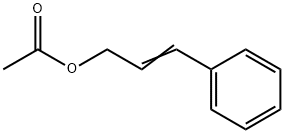
obtained from natural cinnamyl alcohol exhibits a more delicate (hyacinth–jasmine-like) note. | | Occurrence | Reported found in melon, starfruit, tarragon and litchi. | | Uses | Cinnamyl Acetate is used in preparation and characterization of cinnamon essential oil nanocapsules and comparison of volatile components and antibacterial ability of cinnamon essential oil before and after encapsulation. | | Uses | Perfumery (fixative), flavoring. | | Preparation | By direct esterification of cinnamic alcohol with acetic acid (or anhydride) under azeotropic conditions (Arctander, 1969). | | Definition | ChEBI: An acetate ester resulting from the formal condensation of cinnamyl alcohol with acetic acid. Found in cinnamon leaf oil. | | Taste threshold values | Taste characteristics at 15 ppm: sweet, spicy, floral, cinnamon and honey with a tutti-fruitti nuance. | | Synthesis Reference(s) | Journal of the American Chemical Society, 90, p. 5518, 1968 DOI: 10.1021/ja01022a034 | | General Description | Cinnamyl acetate is a fragrance ingredient. Palladium catalyzed allylic alkylation of cinnamyl acetate using sodium diethyl 2-methylmalonate and novel ferrocenyl Schiff base has been investigated. | | Flammability and Explosibility | Nonflammable | | Safety Profile | Moderately toxic by
ingestion and intraperitoneal routes. A skin
irritant. Combustible liquid. When heated to
decomposition it emits acrid smoke and
fumes. See also ALLYL COMPOUNDS. |
| Cinnamyl acetate Preparation Products And Raw materials |
|


 日本语
日本语 한국어
한국어 Français
 Deutsch
 España
 Türkiye