Other grades of this product :
| Exenatide acetate Basic information |
| Exenatide acetate Chemical Properties |
| Melting point | >209°C (dec.) | | storage temp. | Refrigerator, under inert atmosphere | | solubility | Acetonitrile (Slightly), Water (Slightly) | | form | Solid | | color | White to Off-White | | CAS DataBase Reference | 141732-76-5(CAS DataBase Reference) |
| Exenatide acetate Usage And Synthesis |
| Chemical Properties | Exenatide acetate is White Solid
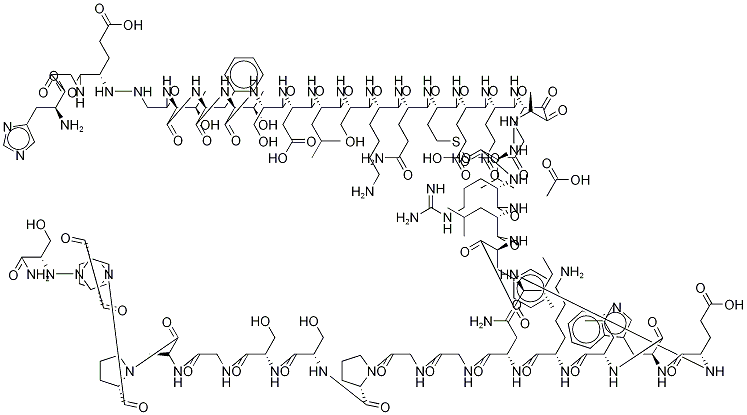
| | Uses | A 39-amino acid peptide originally isolated from the salivary glands of the Gila monster (Heloderma suspectum), differs from exendin-3 only in two positions close to the N-terminus. Application of exenatide causes an increase in acinar cAMP without stimulating amylase release. As an incretin mimetic, exenatide acts as agonist of the glucagon-like peptide-1 (GLP-1) receptor. As GLP-1, though with prolonged activity, exenatide augments the postprandial production of insulin and suppresses secretion of glucagon. For this reason, exenatide has found use as a medication of diabetes II. | | Uses | Application of exenatide acetate causes an increase in acinar cAMP without stimulating amylase release. As an incretin mimetic, exenatide acetate acts as agonist of the glucagon-like peptide-1 (GLP-1) receptor. As GLP-1, though with prolonged activity, exenatide acetate augments the postprandial production of insulin and suppresses secretion of glucagon. For this reason, exenatide acetate has found use as a medication of diabetes II.
| | Clinical Use | 39-peptide known as an incretin mimetic;
an agonist of glucagon-like peptide-1,
used adjunctively in type II diabetes
mellitus. | | Drug interactions | Potentially hazardous interactions with other drugs
Anticoagulants: possibly enhances anticoagulant
effect of warfarin.
Other nephrotoxins: avoid concomitant use. | | Metabolism | Exenatide is eliminated through the kidneys by
glomerular filtration followed by proteolytic degradation. |
| Exenatide acetate Preparation Products And Raw materials |
|


 日本语
日本语 한국어
한국어 Français
 Deutsch
 España
 Türkiye